

IFA has always been a little different from the typical technology trade show. Phones and TVs may grab plenty of attention, but wander far enough through the halls and you are just as likely to encounter a robotic lawn mower, an AI recorder, a portable gym, a flying camera, or some wonderfully strange device that does not fit neatly into an existing category.
IFA 2026 delivered plenty of that variety, but several themes appeared repeatedly throughout the week.
To the surprise of noone, artificial intelligence (AI) continued to work its way into practically everything, though some of the more compelling products moved beyond simply adding a chatbot to an existing device. Local AI processing, contextual memory, autonomous computer control, and smarter home automation pointed toward hardware that is beginning to use AI in more practical ways.
Mobile hardware also had an unusually interesting year. Rather than chasing another round of incremental processor and camera improvements, several manufacturers experimented with displays, modular cameras, rugged designs, and new approaches to portable computing.
Charging and battery technology quietly produced some of the most meaningful developments of the show. Semi-solid-state batteries, increasingly compact GaN chargers, and smarter energy-storage systems suggest the next few years could bring meaningful improvements to products people already use every day.
The smart home was another bright spot. Matter continued to reduce some of the friction between platforms, while lighting, security, storage, and automation products became more sophisticated without necessarily becoming more complicated. Some of the best ideas were not attempting to reinvent the home. They simply made familiar products noticeably smarter.
After following the announcements before, during, and after the show, these are the products that stood out most to the AndroidGuys team.
TECNO Next-Gen Bezelless Concept Phone
AndroidGuys Best Mobile Innovation

Smartphone displays have been slowly pushing toward thinner borders for years, but TECNO took the idea much further at IFA 2026.
Its next-generation bezelless concept phone uses an effectively borderless display that gives the device an almost uninterrupted front surface. It is the kind of design that immediately catches the eye, but the appeal goes beyond appearance.
Phones have reached a point where conventional hardware changes often arrive in small increments. TECNO’s concept instead asks what the smartphone might look like if one of its most familiar physical limitations could essentially disappear.
Concept hardware does not always make its way directly into a retail product, but it often provides an early look at where manufacturers are heading. TECNO’s effort was one of the clearest examples of that at IFA this year.
TCL P80 Ultra
AndroidGuys Best Smartphone Display Innovation

TCL has spent years developing NXTPAPER as an alternative to traditional smartphone and tablet displays, focusing on eye comfort, reduced reflections, and a more paper-like viewing experience.
The P80 Ultra pushes that technology into new territory by combining NXTPAPER principles with AMOLED.
That pairing is significant. AMOLED panels are valued for their contrast, rich color, and deep blacks, while NXTPAPER has historically focused on reducing glare and making screens easier on the eyes.
Bringing those ideas together gives TCL something meaningfully different in a smartphone category that often feels increasingly standardized.
Circular Ring 3 Pro and Ring 3 Slim
AndroidGuys Best Wearable

Smart rings are becoming easier to find, but most still revolve around the same core collection of sleep, recovery, activity, and health metrics. Circular used IFA 2026 to expand what a smart ring can actually do.
The Ring 3 Pro and Ring 3 Slim add features including contactless payments and haptic feedback, moving the category closer to the everyday utility traditionally associated with smartwatches.
Neither feature sounds particularly exotic on its own, but placing them inside a compact ring changes the equation. Users can receive discreet alerts or make a payment without reaching for a phone or wearing a full-sized smartwatch.
That combination of convenience and subtlety earned Circular our Best Wearable award.
Plaud One
AndroidGuys Best AI Device
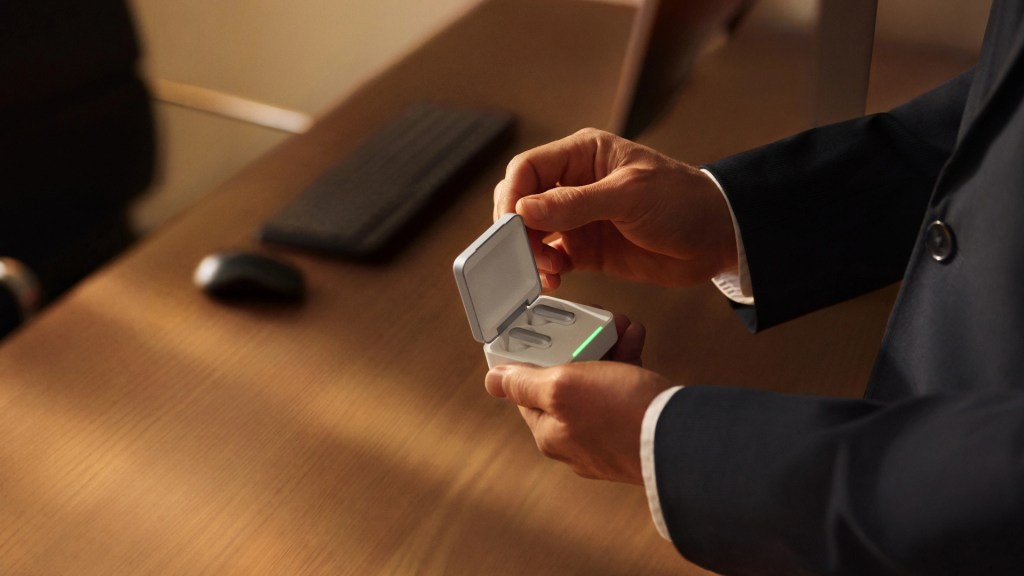
There was certainly no shortage of AI at IFA 2026. The harder task was finding products where artificial intelligence felt integral to the experience rather than another item added to a specification sheet. Plaud One was one of them.
The device combines earbuds, recording capabilities, contextual memory, connectivity, and AI-powered organization into a system aimed at capturing and working with information throughout the day.
Its strength is not simply that it can record a conversation or generate a summary. Plenty of software can already do that. The more interesting idea is treating those interactions as part of a larger personal knowledge system that can retain context and make recorded information useful later.
AI hardware still has plenty of room to mature, but Plaud One offered one of the more convincing glimpses of where the category may be headed.
Belkin UltraCharge Pro with BoostSolid Cell Technology
AndroidGuys Best Charging Innovation

Charging accessories tend to be judged by wattage, port count, and size. Belkin brought something more fundamental to IFA 2026.
Its BoostSolid technology uses semi-solid-state battery cells, an approach designed to improve areas such as energy density, longevity, and safety compared with conventional lithium-ion battery designs.
That makes the technology particularly interesting for portable power banks, where manufacturers are constantly trying to balance capacity, physical size, heat, and durability.
Consumers may not immediately care what chemistry is hiding inside a battery pack, but they certainly notice when that pack becomes smaller, safer, lighter, or lasts longer. Sometimes the most important innovation is the one buried inside the product.
Anker MindBase
AndroidGuys Best Smart Home Innovation

Anker’s MindBase stood out by combining several increasingly important pieces of the connected home into a single device.
It brings together local AI processing, Matter smart-home control, network-attached storage, and automation capabilities, with support for substantial amounts of local storage.
The emphasis on local processing is particularly important. Smart homes increasingly rely on cameras, sensors, assistants, and connected appliances, all of which generate information that does not necessarily need to make a round trip through the cloud.
MindBase points toward a model where more of that intelligence can remain inside the home. It is an ambitious concept, but also one that feels increasingly practical as AI and smart-home platforms become more intertwined.
UGREEN HomeAgent Ecosystem
AndroidGuys Best AIoT Innovation

The smart home is getting more intelligent, but that intelligence does not necessarily need to live hundreds of miles away in a cloud data center.
UGREEN’s new HomeAgent ecosystem takes a local-first approach, bringing AI processing, smart-home control, storage, and automation together under one roof. The HomeAgent HA100 series uses the company’s Uliya assistant to handle voice commands, routines, notifications, and video processing over the local network, while Matter support helps tie compatible third-party devices into the system.
Keeping more of that processing inside the home is what makes HomeAgent especially interesting. Security footage, automation data, and everyday interactions can be handled locally rather than automatically being sent to remote servers, while users are not required to pay a monthly cloud subscription for the core experience.
UGREEN has spent years building chargers, hubs, storage products, and other accessories that live around our devices. HomeAgent feels like a logical next step: connecting those pieces into a smarter ecosystem while keeping much of the intelligence close to home.
That local-first philosophy, combined with Matter support and serious on-device AI capability, earns the UGREEN HomeAgent ecosystem our Best AIoT Innovation award.
Hohem Eyepic
AndroidGuys Best Creator Device

Hohem’s Eyepic takes a familiar creator tool and gives it a clever twist.
At first glance it resembles the increasingly popular compact camera-and-gimbal systems used for vlogging, travel, and social video. The difference is that its 4K camera can detach from the gimbal and operate independently.
That simple change opens up considerably more flexibility.
The camera can be positioned separately for unusual angles, remote shots, or situations where carrying an entire gimbal system would be inconvenient. Reattach it and it returns to being a stabilized handheld camera.
For creators who increasingly work with lightweight equipment and unconventional shooting setups, that versatility makes a lot of sense.
XGIMI AURA 3 Max
AndroidGuys Best Home Entertainment Product

Ultra-short-throw projectors continue to narrow the gap between traditional televisions and projection systems, and the XGIMI AURA 3 Max was one of the strongest home-theater products at IFA 2026.
The projector combines 4K resolution with support for a 120Hz refresh rate, giving it appeal for movies, streaming, sports, and gaming. The bigger attraction is the form factor.
An ultra-short-throw projector can produce a very large image while sitting close to the wall, eliminating much of the installation hassle associated with traditional projection systems.
For anyone trying to build a theater-sized viewing experience without permanently mounting equipment across the room, the AURA 3 Max presents a compelling option.
Reolink OMVI 2i Ultra
AndroidGuys Best Smart Home Security Product

Security cameras have become remarkably capable, but Reolink continues to find ways to squeeze more intelligence and flexibility into the category.
The OMVI 2i Ultra combines dual-view tracking, 4K video, wire-free installation, solar charging options, local storage, and Reolink’s ReoNeura AI platform.
The dual-camera approach is particularly useful because it can provide both a wider view of an area and a closer look at activity occurring inside it.
Add local storage and solar-powered operation and the system becomes appealing for locations where running power or relying entirely on cloud services may not be desirable.
It is a thoughtful collection of features built around how people actually use outdoor security cameras.
Speediance Gym Monster 3
AndroidGuys Best Fitness Technology

Connected fitness equipment has shifted significantly over the past few years, moving away from simple screen-based workouts toward increasingly sophisticated digital resistance systems. The Speediance Gym Monster 3 represents that evolution well.
It combines digitally controlled resistance, guided training, performance tracking, and a relatively compact footprint to create a strength-training system aimed at users who want the flexibility of a home gym without filling an entire room with plates and racks.
The value of systems like this comes from more than saving space.
Digital resistance allows the machine to change how resistance behaves throughout an exercise, while software can track workouts, weight, repetitions, and progress without requiring users to maintain their own training logs.
For anyone trying to bring serious strength training into a home environment, the Gym Monster 3 makes a convincing argument.
RugOne Xsnap 7 Pro
AndroidGuys Best Outdoor and Rugged Innovation

Rugged smartphones usually follow a familiar recipe: oversized battery, reinforced body, water resistance, and perhaps a thermal camera or unusually bright flashlight.
RugOne took a more creative approach with the Xsnap 7 Pro. The phone includes a detachable action camera, allowing users to remove the camera from the handset and position it separately while continuing to use the phone as part of the system.
That immediately expands what a rugged phone can do for hiking, biking, job sites, travel, and outdoor recreation.
Rather than simply making the smartphone harder to break, RugOne found a way to make the hardware itself more useful once users leave the pavement behind.
Linkind T19 Smart Flame Light Bulb
AndroidGuys Best Smart Lighting Innovation

A smart bulb might sound modest beside folding phones, AI hubs, and home gym systems, but Linkind’s T19 is a good example of how much room remains for clever ideas in familiar product categories.
Rather than relying on a simple flickering effect to imitate fire, the T19 uses 160 LEDs divided across 50 individually controllable zones. Users can adjust the size, brightness, speed, and movement of the flame effect, producing everything from a subtle candle-like glow to a more animated fireplace effect.
It is also a practical everyday bulb. The T19 produces up to 850 lumens, supports 16 million colors and tunable white light, and offers more than 120 preset scenes through the AiDot app. Matter compatibility allows it to work across major smart-home platforms, while its standard E26 base means installation is little more complicated than changing a bulb.
What makes the T19 interesting is that the technology does not demand a new fixture or dedicated piece of decorative hardware. Linkind packed a highly customizable ambient lighting system into something people already know how to use.
That combination of accessibility, creativity, and smart-home compatibility earns it our Best Smart Lighting Innovation award.
A Year Defined by Practical Experimentation
The strongest products from IFA 2026 were not necessarily the ones with the biggest specification sheets. Many of our favorites took familiar categories and approached them from a different angle.
TECNO and TCL reconsidered what smartphone displays can look like. Circular added everyday utility to the smart ring. Belkin focused on the battery chemistry hidden inside the products we already carry. Hohem and RugOne found new ways to separate cameras from the devices that traditionally hold them.
Meanwhile, products from Plaud, Anker, Reolink, and Speediance demonstrated how software and AI can become more valuable when they are closely tied to hardware designed for a specific job.
IFA remains at its best when companies are willing to experiment.
Not every idea introduced in Berlin will become mainstream, and some may never make it beyond their first generation. That is part of the fun. The products above stood out because they offered something genuinely interesting, useful, or different enough to make us pay attention.
Those are the devices and technologies that earned our AndroidGuys Best of IFA 2026 Awards.


