

ASUS Republic of Gamers (ROG) and XREAL have officially opened pre-orders for the ROG XREAL R1, a pair of gaming AR glasses designed to transform handheld and PC gaming with a massive virtual display and ultra-smooth visuals. First shown off at CES 2026, the R1 became available for pre-order through Best Buy on May 15, 2026 at 3:30 PM TPE (UTC+8), with the XREAL Official Store following suit on May 17, 2026 at 12:00 AM PDT (UTC-7).
240Hz Micro-OLED Meets Theater-Sized Gaming
The ROG XREAL R1 claims the title of the world’s first 240Hz micro-OLED gaming AR glasses, pairing that refresh rate with a 0.01ms response time and the ability to project a 171-inch virtual screen. Built on XREAL’s XR technology, the glasses offer a 57° field of view that covers up to 95% of the user’s focused vision—essentially creating a theater-sized gaming environment that fits in your bag.

The 0.55-inch Sony micro-OLED panels deliver 1920 x 1080 resolution per eye, 106% sRGB color gamut, and peak brightness of 700 nits when increased brightness mode is enabled. Motion-to-photon latency sits at 3ms, which should keep gameplay feeling responsive without motion blur or jittering. At just 91 grams, the R1 is light enough for extended gaming sessions without the neck strain that typically comes with heavier headsets.
Built for the ROG Ally (But Not Exclusive to It)
While the R1 works as a plug-and-play solution across various handheld and mobile devices, it’s been optimized specifically for the ROG Ally. When paired with ASUS‘s handheld gaming PC, the R1 enables a dual-display setup: the glasses project the main gaming view on that 171-inch virtual screen, while the Ally’s built-in display remains active for real-time adjustments.
Users can tweak brightness, screen size, aspect ratio, tint level, frame-rate boost, and toggle spatial locker and 3D mode directly through the Ally’s Armoury Crate SE app—all without pausing the game. It’s a thoughtful integration that turns the Ally’s screen into a control panel rather than letting it go to waste.
PC Control and Spatial Computing
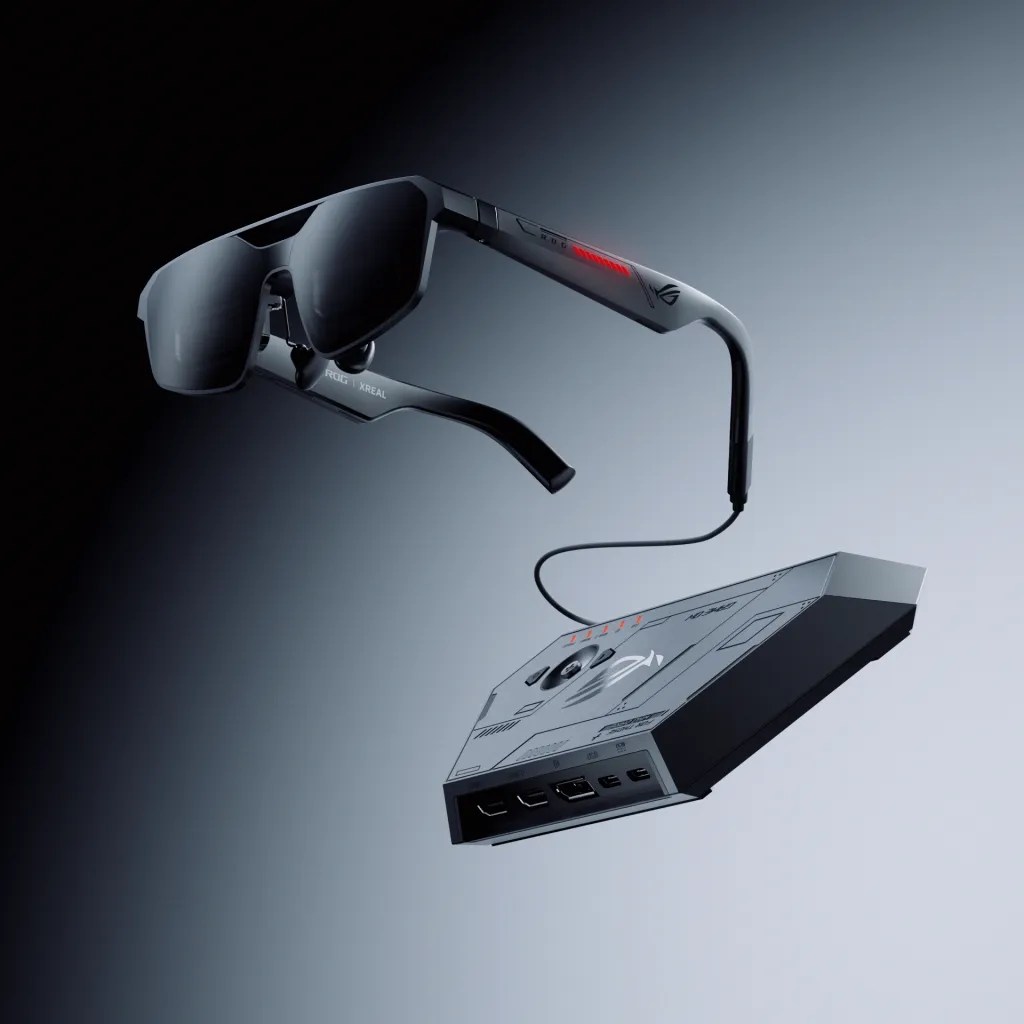
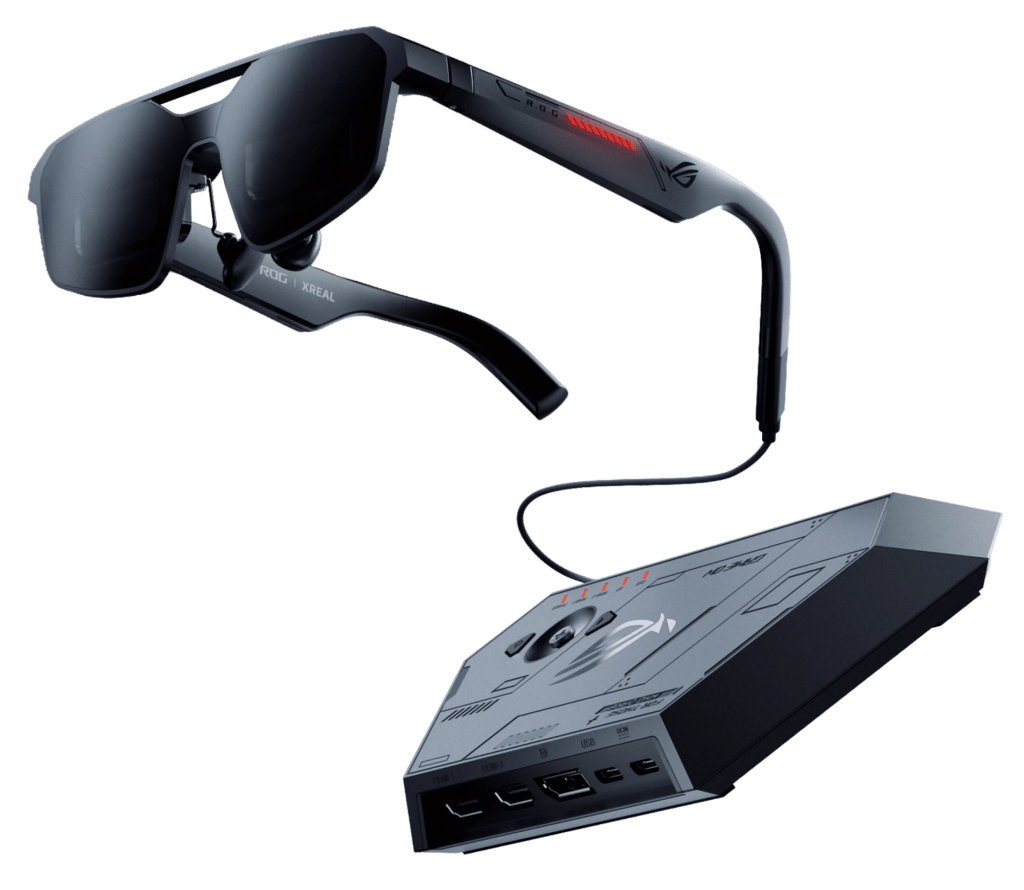
For PC gamers, ROG includes a Control Dock that connects with the ASUS DisplayWidget Center software, enabling keyboard and mouse control over the virtual display. This setup allows users to manage spatial layouts, deploy GamePlus enhancements like AI-enhanced Dynamic Crosshairs and timers, and take advantage of AI Visual technology that automatically detects on-screen content and adjusts the viewing mode accordingly.
The R1 is powered by XREAL’s X1 spatial computing chip, which provides native 3 Degrees of Freedom (3DoF) support with 6DoF also supported. This enables two key modes: Anchor mode, which pins the virtual display to a fixed position in your physical space, and Follow mode, which tracks with your head movements. The glasses also feature real-time 2D-to-3D conversion, adding depth and scale to existing game libraries without requiring native 3D support.
Adaptive Lenses and Spatial Audio
One of the more practical features is the electrochromic lens technology, which adjusts transparency based on where you’re looking. The lenses can automatically become transparent when you glance away from the anchored screen and tint again when you return your gaze, using head-tracking to detect engagement.

There are three manual tint levels to choose from, plus a one-click instant transparency feature for quick adjustments. Digital IPD adjustment is also included for a more personalized fit. Audio is handled by Sound by Bose technology, which delivers spatial audio designed to enhance immersion with lifelike clarity and directional accuracy.
More details about the ROG XREAL R1 can be found on the official XREAL website.


