

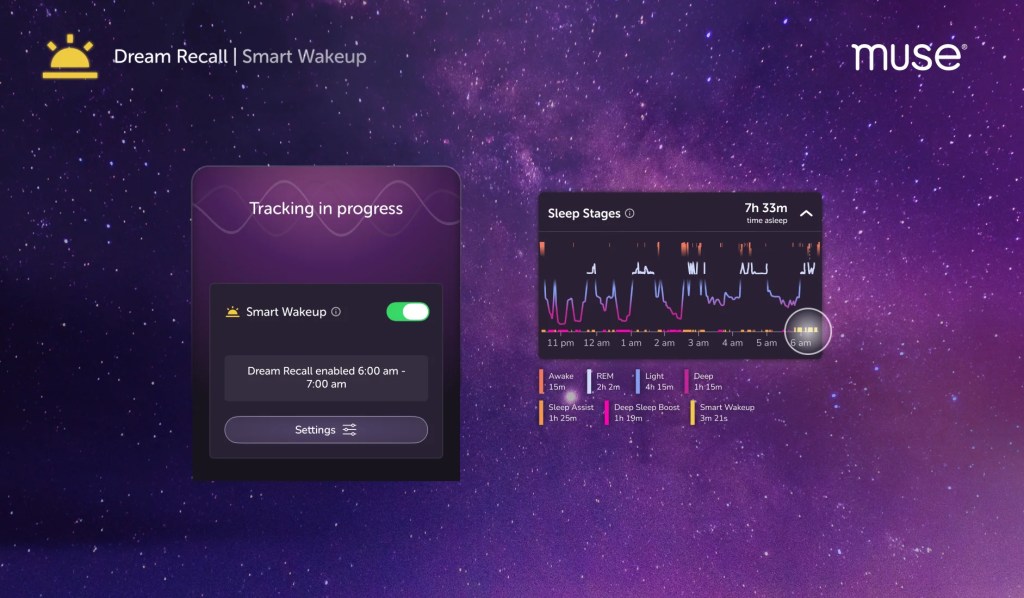
Muse has a timing problem it wants to solve for you, and this one happens while you sleep. The Toronto-based neurotechnology company has opened the beta for Dream Recall, a new feature built into its Smart Wakeup system that times your wake-up alarm to coincide with an active dream, giving your brain the best possible chance of holding onto it.
The science behind the feature is straightforward: wake someone during a dream, and they remember it about 80% of the time. Wake them just minutes later, and that drops to roughly 7%. Dream Recall is designed to land you in that first window, not the second.
Why Dreams Are Worth Keeping
The case for dream retention goes well beyond curiosity. Research from Harvard Medical School found that people who dreamed about a newly learned maze task improved roughly ten times more on a follow-up test than those who slept the same amount without dreaming about it. A separate study out of Paris found that participants who drifted into even one minute of light sleep were nearly three times more likely to find a hidden shortcut in a number puzzle (83% versus 31% for those who stayed awake). Sink into deeper sleep, and the effect disappeared entirely.
Dreams also appear to do emotional heavy lifting. Suppressing REM sleep for a single night measurably increases negative mood the following morning. And in 2021, four independent labs across France, Germany, the Netherlands, and the United States conducted real-time, two-way exchanges with lucid dreamers during REM sleep, a finding that pushed dream science firmly out of the esoteric corner.
The forgetting, it turns out, is structural. During REM sleep, the brain chemistry responsible for filing experiences into long-term memory goes quiet. Dreams are never encoded the way waking events are, and the first moments of waking, movement, light, and incoming thoughts, overwrite whatever fragile trace remains. A 2021 CBS News poll found that only about one in ten adults say they always remember their dreams, and more than a third of adults over 30 say they rarely or never do.
How Dream Recall Works
What sets Muse apart from wrist-worn trackers and smart rings is that it reads sleep directly from the brain via EEG, rather than inferring sleep stages from movement or heart rate. That staging has been independently validated against clinical polysomnography at the University of Ottawa (in research Muse did not fund), achieving 88 to 96% per-stage agreement with expert-scored lab results.
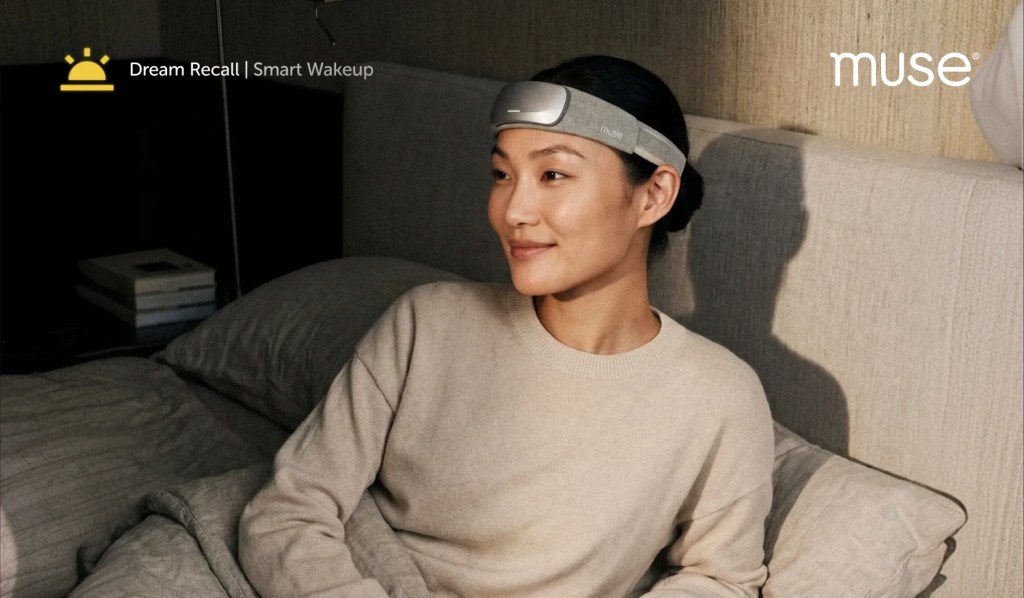
Dream Recall puts that precision to work in three ways. First, it times your wake to an active dream. Second, Auto-Snooze gradually steps back the wake sound as you begin to surface, holding you at the edge of sleep so you can slip back into the dream rather than lose it. Third, a sound cue rehearsed while awake can travel with you into the dream and serve as a recognizable signal from inside it.
The feature sits within Muse’s broader Sleep, by Design toolkit, which also includes Sleep Assist (for falling asleep faster), Deep Sleep Boost (for strengthening slow-wave sleep), and Smart Wakeup (for waking at the lightest point of your final sleep cycle).
“Dreams do not belong on the esoteric shelf,” said Chris Aimone, Co-Founder and Chief Innovation Officer at Muse. “We are excited to see what people do with their dreams once they can hold onto them.”
Availability
Dream Recall is available now in beta to current Muse Premium subscribers using a Muse S or Athena headband. Sleep Assist and Deep Sleep Boost are included free with every Muse S device.


