

WiCi, the startup behind what it calls the world’s first wireless GPU, is making a notable move in the local AI space with the launch of WiCi Infer. The free desktop application pairs with an open-source inference engine called InferSSD, and together they tackle one of the more stubborn limitations of running large language models locally: memory.
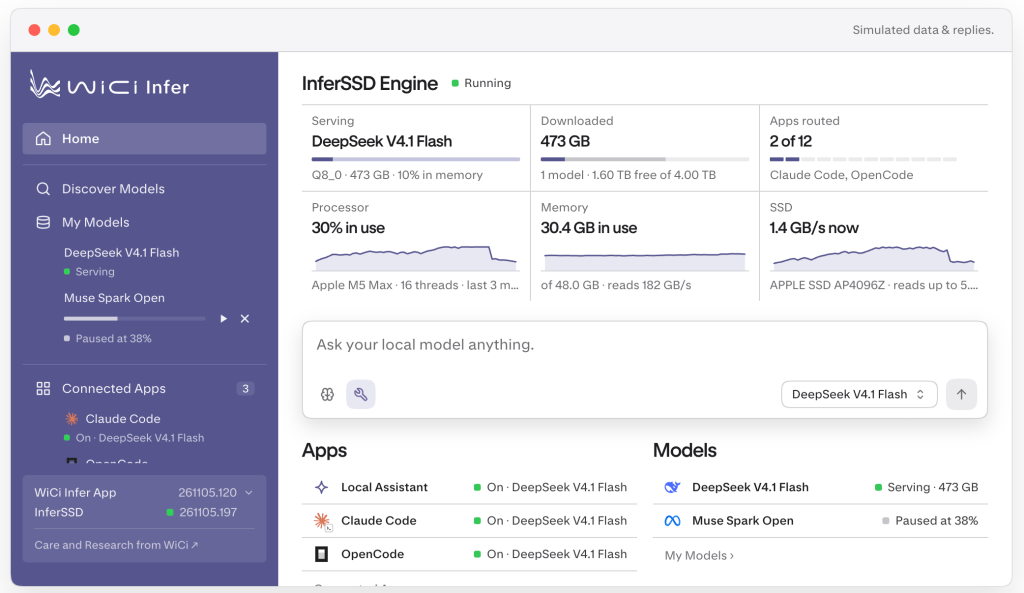
Most local AI tools require the entire model to fit within available RAM or GPU memory before anything happens. WiCi Infer sidesteps that constraint entirely. InferSSD streams only the expert weights needed at any given moment directly from the SSD, handling expert indexing, router-driven streaming, and adaptive CPU/GPU scheduling on the fly. The practical result is that users can run 800-billion-parameter models like DeepSeek V4.1 Flash (763B) or Muse Spark Open (816B) on consumer hardware, without extra compression and without needing the memory headroom those models would traditionally demand.
Performance Numbers Worth Noting
WiCi’s internal benchmarks put InferSSD well ahead of llama.cpp across a range of hardware configurations. On a MacBook Pro with an M5 Max and 48 GB of unified memory, InferSSD delivered 6.2x the decode throughput of llama.cpp on the Muse Spark Open model. On an NVIDIA DGX Spark with 128 GB unified memory, that figure climbed to 17.8x, measuring 2.14 tokens per second for InferSSD versus 0.12 for llama.cpp at the 4K prompt tier. Results vary by model, hardware, and settings, but the gap is consistent across configurations tested.
WiCi Infer also scales down gracefully. Smaller models like Qwen3 (35B) can run on machines with as little as 8 GB of memory, making the app relevant well beyond high-end workstations.
A Drop-In Tool for Developers and Power Users

One of the more immediately useful features is WiCi Infer’s OpenAI-compatible API endpoint. Any application that supports a custom model endpoint, including coding tools like Claude Code and OpenCode, can route requests to the locally running model without any workflow changes. No reconfiguration, no new integrations. The app also includes a built-in chat interface for users who want to interact with downloaded models directly.
The InferSSD engine is open source from day one, available for developers to inspect, build on, and contribute to. A technical deep dive is available for those who want to get into the specifics of how the engine handles weight residency and scheduling.
Free to Download, No Strings Attached

WiCi Infer is available as a free macOS download with no subscription and no login required. The app includes a model browser for discovering and downloading supported LLMs, a conversation interface, and the full InferSSD engine underneath. It’s a notably low-friction entry point for anyone curious about running frontier-scale models locally.
For users who want to push further, WiCi also offers WiCi One, a hardware device that brings a full-power NVIDIA GPU to compatible devices over Wi-Fi, running the same InferSSD engine and WiCi Infer experience.
More details, benchmarks, and the desktop app download are available at the official WiCi website.


