Just in time for Prime Day on October 7-8, Lepro is illuminating the market with discounts of up to 38% on their innovative indoor and outdoor color-changing smart lighting solutions. Customers can avail of these deals to transform their spaces into stylish and ambient havens.
Lepro is not just another smart lighting brand. It stands apart with its unique LLM-based LightGPM™ and LightBeats™ technologies, which allow the generation of custom lighting scenes from voice and text prompts and intelligent rhythm synchronization respectively.
Smart Lighting Prime Day Deals
The Prime Day deals include discounts on a variety of products. The E1 AI Permanent Outdoor Lights are available at discounts ranging from 34% to 36%. The TB1 AI Smart Table Lamp and TB2 AI Smart Table Lamp are available at 28% and 15% discounts respectively. The R2 AI 6 Inch LED Recessed Light is available in 2-Pack and 4-Pack options at 35% and 38% off respectively.
The S1 AI LED Strip Lights range in length from 16.4 ft to 100 ft, with discounts ranging from 11% to 27%. The B1 AI Smart Light Bulbs come in 2-Pack and 4-Pack options at 35% and 33% off respectively.
As a leading provider of smart lighting solutions, LePro is primarily devoted to offering innovative and stylish solutions for indoor and outdoor lighting needs. The company prides itself on making lighting customization easier and more interactive.
MobileX, a leading customizable wireless service provider, today announced the upcoming launch of its new feature, the Gold Network. This unique service offers customers priority data on demand, a feature that other carriers have yet to provide. By running on QCI 8, the Gold Network ensures faster speeds and lower latency during periods of peak congestion, whether at crowded events or in busy everyday areas.
Benefits and Access Options for The Gold Network
The Gold Network is designed to deliver improved performance during times of network congestion, allowing customers to enjoy smoother streaming, more reliable video chat, and a more responsive overall experience. Customers can opt for Gold On Demand for a one-time speed boost during high-traffic events, or they can choose Gold Unlimited or Gold Build Your Own for continuous monthly priority data access.
MobileX’s founder and CEO, Peter Adderton, stated that the Gold Network gives customers the power to decide when they want to upgrade to priority access. For those who do not require priority data, they can continue to rely on MobileX’s regular high-speed data, which has now been reduced to $1.90 per GB (from $2.10).
Availability
The Gold Network will be available next month (November) via the MobileX app, under XtraOptions. New customers can download the MobileX app from the Apple App Store and Google Play, or purchase a MobileX SIM starter pack at over 3,700 Walmart stores and on Walmart.com.
In an exciting development for tech enthusiasts and adventurers alike, T-Mobile has announced a significant expansion of its T-Satellite service, powered by Starlink’s 650+ satellites. This expansion introduces satellite data connectivity for several popular apps, extending their reach to places where traditional cell signals dare not tread.
The Satellite-Powered App Experience
Building on the initial success of T-Satellite’s messaging services launched earlier this year, users in the U.S. can now enjoy essential apps like WhatsApp, AllTrails, AccuWeather, and Google Maps even in the most remote locations. This advancement means that voice and video chats on WhatsApp, among other features, are now possible via satellite, offering users a new level of communication freedom. Picture this: having a video call with friends while hiking in a secluded canyon, with no cell tower in sight.
Mike Katz, President of Marketing, Innovation, and Experience at T-Mobile, expressed his enthusiasm: “We’ve been astounded by the positive feedback from T-Satellite’s initial launch. Extending support to critical apps and services not only enhances safety but also offers peace of mind to our users, allowing them to stay connected anywhere they can see the sky.”
Apps That Go Beyond Boundaries
The integration of satellite connectivity has opened up a new realm of possibilities for app usage. Notable mentions include:
AllTrails: Navigate and explore over 500,000 trails with real-time location sharing, no matter how far off the grid you go.
AccuWeather: Access hyper-local forecasts and storm alerts, ensuring you’re prepared for any weather conditions, no matter where your adventure takes you.
CalTopo: Perfect for planners, offering custom map-building capabilities for hikes and trips, now enhanced with real-time satellite connectivity.
onX Suite: From hunting to offroading, these apps provide comprehensive data for outdoor enthusiasts, even in the most isolated areas.
X: Stay updated with trending topics and social media interactions, maintaining your digital presence even in remote locales.
For businesses, the T-Satellite service offers vital connectivity enhancements. Integrations with platforms like Dialpad and FLORIAN enable seamless communication during outages or in areas lacking terrestrial coverage, proving invaluable for field teams and first responders.
Seamless Connectivity for All
Using satellite-ready apps remains straightforward for T-Mobile customers. The phone automatically switches to satellite mode when terrestrial signals are unavailable, maintaining a seamless experience without the need for manual adjustments. This ensures that the critical services offered by these apps are available wherever you are, without the data-heavy demands of traditional networks.
T-Satellite service is included at no extra cost in T-Mobile’s premium plans, and for a modest fee, users of other networks can also benefit from this groundbreaking service. The initiative isn’t just for existing customers; developers are encouraged to connect with T-Mobile to explore the potential of keeping their apps live and accessible in this new era of connectivity.
With T-Satellite, T-Mobile is reshaping the landscape of connectivity, ensuring that being off the grid no longer means being out of touch. Whether you’re scaling mountains or simply escaping to a remote retreat, staying connected is now as easy as looking up at the sky.
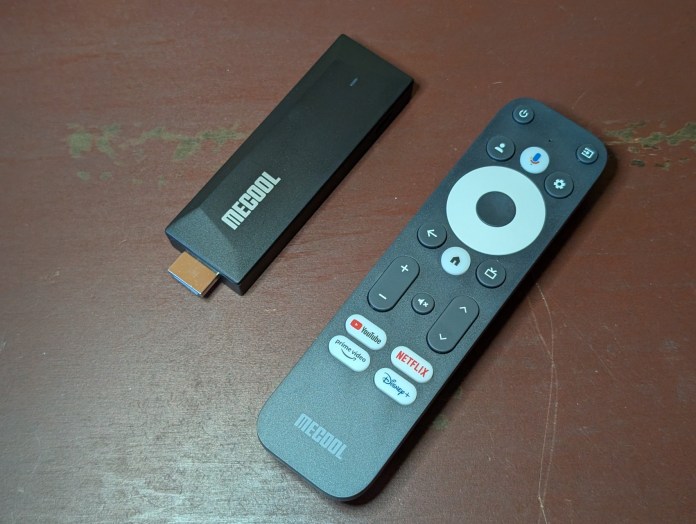
Mecool probably isn’t on your radar if you need a streaming device for your television, but maybe they should be. The company makes a wide range of options running Android TV and the newer Google TV software by Google. I’ve recently been testing the latest addition to the Mecool lineup in the MEgo1 4k Streaming Stick.
Design
The build of the MEgo1 is pretty standard for a TV streaming stick. You get basically a glorified thumb drive with a male HDMI port on one end. The only other port is the power input, provided in this case by a USB-C option. There’s also the Mecool branding and blue LED status light to let you know you have it powered on and ready to stream.
Internally, the MEgo1 is powered by a Realtek RTD1325 ARM chipset, paired with 2GB of RAM and only 8GB of storage. This should be fine to run most apps, but I’m immediately concerned out of the box that I’ll be running out of storage.
The included remote is very good. Mecool has followed the Google TV remote guidelines almost to the specs, and that’s a positive. The MEgo1 layout is intuitive, modern, and uncluttered while still offering the buttons you truly need. There are dedicated shortcuts for YouTube, Netflix, Prime Video, and Disney+ at the bottom which should cover some of the most used apps in any household at this point.
Setup and Performance
Getting a Google TV device up and going is easier than it’s ever been. Logging into the MEgo1 takes just a few minutes with Google’s fantastic account setup from your phone’s existing accounts. Using a QR code to the link, the two devices syncs the needed information seamlessly over Wi-Fi.
Daily use of the Mecool MEgo1 Streaming Stick has been OK. When you first get it setup and settled, the UI is fairly snappy and transitions are decent between apps. I had no issues getting my favorite apps installed and ready to veg-out on the couch.
It’s when you get these apps installed and used for a few days, you start to see some limitations. I’d estimate that I’m more the majority than the minority that in today’s streaming situation, it takes you at least five services to enjoy all the media subscriptions you’re paying for.
Due to the size and RAM caching of these apps, the 2GB of RAM and the internal storage only being 8GB starts to show after a few weeks of use. It didn’t take long to start seeing more stuttering when moving between the interface as RAM became scarce.
The same is true for actually memory becoming full as the apps offloaded data into the internal storage. The issue arrives almost immediately due to the 8GB of storage also includes the underlying operating system taking up well over half at around 4.5GB. This leaves user apps with a paltry 3.5 to 4GB of real storage at their disposal.
I think for most users, especially at $70, there’s a need for at least double of each of these defaults found on the MEgo1. I’d worry less about 4GB of RAM, and even 16GB of storage would still make me nervous. One of the most seen complaints around the launch of Google’s own Chromecast with Google TV is that it only comes with 16GB of storage.
“For a user looking to get a 4K Google TV stick, the Mecool MEgo1 is a confounding product. Priced at $70, its middling specs make it a tough sell when similar devices from competitors are a third of the price, and a better-specced Mecool box is available for the same cost.”
Software
The Mecool MEgo1 is a pretty standard affair for Google TV devices. You have Android’s television operating system with a fairly clean, and snappy interface. It’s focused around the company’s user data and tries to surface the next available show you want to watch based off your history and trends.
It is nice that the MEgo1 is certified for all the major streaming apps. Netflix, Disney+, and Amazon Prime Video are all here with full 4K support. This can be a deal-breaker for some brands, but Mecool has this covered with zero issues in my testing. When you need to find that niche streaming app, the full Play Store is available as well.
Final Thoughts
The Mecool MEgo1 is a bit of a confounding product addition for the company. Historically, their streaming devices are usually on the high-end with a budget pricing. The MEgo1 is somewhat of the exact opposite. The middling, and almost minimal specs, for a price of $70 makes this a hard sell. You can easily get a similar streaming stick running Google TV from other brands for around a third of the price, or for the about same price, you can get a better streaming box from Mecool like the KM9 Pro.
Hold onto your hiking boots, folks! Suunto just dropped the Vertical 2, and trust us, this isn’t just another GPS sports watch—it’s positioning itself as the new generation of the ultimate companion, ready for both the highest peaks and your everyday adventures. Whether you’re an extreme expedition fanatic or just trying to track that daily run, Suunto designed the Vertical 2 to seamlessly blend endurance and performance.
Let’s dive into the major features that are going to make this watch a must-have on your wrist!
Brighter, Faster, and Built to Last
Say goodbye to squinting at your maps! The Vertical 2 boasts a larger, brighter, and energy-efficient 1.5-inch AMOLED display. With a resolution of 466 x 466 pixels and utilizing LTPO-Display-Technologies, this screen promises exceptional clarity and readability, even when you’re staring straight into the sun. Maps and metrics will stay crystal clear no matter the environment.
Running demanding navigation tools requires serious speed. Suunto upgraded the processor and expanded the memory, making the user interface faster and smoother than before. Plus, this update ensures the watch is ready for all kinds of future software updates.
For the serious data junkies, the Vertical 2 features a completely redesigned optical heart rate sensor. This improved tech offers even higher accuracy for heart rate measurement right at the wrist, supporting everything from training and recovery tracking to general health monitoring. It also includes HRV measurement (Heart Rate Variability).
Never Get Lost (Or Stuck in the Dark!)
If you love tackling mountainous or hilly terrain, the new Climb Guidance function is a game-changer. This feature helps users prepare and navigate by providing real-time elevation profiles, color-coded route sections, and advanced notifications about upcoming ascents and descents. It brings detailed insights into gradients, distances, and altitude differences, significantly improving both route planning and on-trail navigation.
You’ll get sophisticated navigation tools supported by free, detailed offline maps right on the watch and in the Suunto app. These detailed maps include contour lines, paths, and terrain features, making route planning precise. And for those spontaneous moments, Quick-start navigation allows you to change your route mid-activity without pausing the recording!
Here’s a practical addition for safety and comfort: an integrated LED flashlight built right into the bezel. Perfect for low-light situations, the flashlight has adjustable brightness levels, a red light mode for night vision, and key safety modes like SOS and Pulse functions—light when you need it most, whether you’re in a tent or an emergency situation.
Endurance That Won’t Quit
The Vertical 2 is known for its rugged design and exceptional battery life.
Marathon Battery: Even in the most accurate Dualband-GNSS mode, the Vertical 2 manages an impressive 65 hours of GPS-tracking. For daily use, you can expect up to 20 days of Smartwatch usage, and it can be fully recharged in just two hours!
Tough as Nails: Designed for long days and built for durability, the watch is available in robust stainless steel (87 grams) or lightweight titanium (74 grams). It features sapphire crystal and is waterproof up to 100 meters (10 ATM). Plus, three side buttons ensure easy operation in any weather—even while wearing gloves.
Sporting Smarts: Beyond adventure, the Vertical 2 supports training with over 115 sport modes (including 22 new options for trail running, cycling, swimming, and skiing). You also get features like sport-specific heatmaps, weather alerts, recovery trackers, and the Suunto Coach for data-supported training guidance.
The Suunto Vertical 2 stainless steel model is priced at $599.00, and the titanium version is $699.00. You can snag one starting September 30, 2025, on suunto.com and at selected retailers worldwide. Go get your next adventure started!
I’m a big fan of OnePlus. That’s been pretty evident by my coverage here on AG over the years. The company has found a fantastic balance between forward-thinking hardware, unique user interfaces, and budget in the Android market. The same is true for the wireless earbuds segment with the OnePlus Buds brand.
The company has done is again with the new OnePlus Buds 4 and let’s dive into why I think these are some of the best “barely not flagship” earbuds on the scene.
Design
The OnePlus Buds 4 build off the previous line from OnePlus. You get the same teardrop and stemmed earpiece with silicone passive hardware noise suppression. I’ve found the Buds 4 comfortable and stayed very stable in my ears.
One thing that OnePlus included this year that I love is the new capacitive features. The Buds 4 keep the larger area on the main top portion of each earpiece. This serves for play/pause and taking calls like most other earbuds. Where they expanded is a new vertical strip on the stems that can control volume.
I love that these types of interactions make it from the more premium OnePlus Buds Pro 3. It’s not the same as the pressable portion of the stem on those buds, but it’s the same concept. Having quick access to volume controls seems trivial until have earbuds like the Buds 4 and can’t see how you lived without it.
Internally, you have all the makings of modern wireless earbuds. It all starts with the active noise cancellation, capable of 55db of reduction. You also get Bluetooth 5.4 with Google Quick Pair and 11mm woofers and 6mm tweeter pumping out the sound.
“The new capacitive volume controls on the stems are a feature I absolutely love; it’s the kind of quick access that seems trivial at first, but once you have it, you can’t see how you lived without it. The audio quality is just as impressive, delivering a balanced sound that packs a punch, and the battery life is solid enough to easily get me through a full workday with ANC on.”
Sound
Since we’re on the subject, let’s talk about the listening experience. I don’t know how much the OnePlus Bud 4 bring to the table over last year’s Buds 3, but that’s a positive. That’s because that was already a fantastic sounding earbuds.
OnePlus always excels at this, and the combination of ANC and sound quality is very good. The noise cancellation makes sure the majority of your outside interference is curbed to a minimum. Is it as immersive as canned alternatives, no, but it’s well above the standards of $130 earbuds. I’d match these up to any other on the market.
The same is true on audio playback. OnePlus has found a winning formula over the last few generations that carries over to the Buds 4. The mix of the woofers and tweeters is balanced while still packing a punch when called for in the music. Whether you are listening to a muted podcast or a banger, you’ll enjoy what the OnePlus Buds 4 earbuds pump out.
Battery Life
OnePlus estimates that the new Buds 4 will last up to six hours with ANC on and around 11 hours with it turned off. I’ve found this to be relatively accurate. I am able to get through a full eight-hour shift, while taking a few breaks, with no issues of endurance with ANC turned on.
In true OnePlus fashion, when you do run out of battery, it’s a quick solution. The case gets you around three extra charges of the earbuds without reaching for a power adapter or outlet. When you do need to top off the entire package, there’s USB-C quick charge and wired charging. You can get around 3.5 hours of playback back in under 10 minutes, and full charge of the case and Buds 4 in a little over an hour. My only knock is at this price point, you should include Qi wireless charging.
Final Thoughts
Awarded to products with an average rating of 3.75 stars or higher, the AndroidGuys Smart Pick recognizes a balance of quality, performance, and value.
Products with this distinction deserve to be on your short list of purchase candidates.
OnePlus brings another compelling option to the wireless earbuds market with the Buds 4. The active noise cancellation, quality sound, and above average battery life make them worth the $130. Add in the new capacitive volume controls and I think you should just buy them if already shopping earbuds.
You can purchase the new OnePlus Buds 4 for the previously stated $130 in two colors: Storm Gray and Zen Green. The Zen is very subtle in our review models and can be mistaken for Gray as well, but the hint of greens shines through when under lights at an angle. If you act now, you can use code HARVEST to save $30 from general purchase.
SteelSeries, the original esports brand, today announced the launch of its groundbreaking Arctis Nova Elite headset. This headset, the first of its kind to receive Hi-Res Wireless Certification, redefines the limits of gaming audio technology with its meticulous design, engineering, and craftsmanship.
Advanced Wireless Audio Technology and Multi-Source Connectivity
The Arctis Nova Elite delivers a Hi-Res Wireless Certified immersive listening experience across PlayStation, Xbox, Nintendo, and PC. This is made possible through 24-Bit/96KHz transmission over 2.4GHz and Bluetooth, powered by a new GameHub and next-gen LC3+ codec. The headset’s custom 40mm Carbon Fiber Speaker Drivers provide unparalleled accuracy and performance, reproducing frequencies from 10Hz to 40kHz.
The Arctis Nova Elite also introduces OmniPlay, a first-of-its-kind technology that allows users to connect, mix, and play up to four sources on PC, Console, Bluetooth, and Line-In simultaneously. This feature, combined with Triple USB-C inputs, enables seamless transitions between all connected devices for true audio multitasking.
Premium Design and All-Day Comfort
Additional features include the best Active Noise Cancellation (ANC) in gaming, AI Noise Rejecting Microphones, and the Arctis App with 200+ game-specific audio presets. The headset also boasts an Infinite Power System that provides unlimited battery life with a dual-battery system.
Designed in conjunction with renowned designer Jacob Wagner, the Arctis Nova Elite combines Scandinavian minimalism with functional elegance. It features an all-metal frame, metal control wheel, and plush memory foam ear-cups for exceptional comfort.
Availability and Price
The Arctis Nova Elite is available at SteelSeries.com and select retailers worldwide from September 30 for MSRP: NA $599.99 | UK £599.99 | EMEA €649.99 | APAC $649.99.
If you’ve been following along our journey here at AndroidGuys, you know that we are big fans of Anker and its sub-brands. The brand we may feature the most, is Soundcore, the company’s audio and theater outlet. As usual, Summer leading into Fall brings out launches of many new devices.
Soundcore has shared three of its new lineup with us, and we’ve come away convinced that you can’t go wrong with any of them.
Level Up is where we explore the gear that actually makes a difference, whether that’s in how you live, work, or unwind. Each edition brings together standout products, whether tied by brand or by theme, that turn the everyday into something a little more exceptional.
Soundcore P40i ANC
Let’s start with the most “basic” of the group, the new Soundcore P40i. These earbuds are a solid pair of teardrop and stem buds we’ve all come accustomed to from Anker. The quality is good, the case is small, and the sound is all Soundcore appropriate. There’s also touch controls in a capacitive area of each earpiece.
Add in an active noise cancellation and up to 60 hours of total playback, the special price of $48 at launch is a steal. There’s even a new “hidden” feature of a phone kickstand built into the inside of the case. This make commute media watching even easier the next time you travel with the Soundcore P40i ANC earbuds.
This might be my favorite mashup Anker has ever done. How can a company built on portable power solutions also innovate on the audio line? Yep, let’s add a full power bank to the earbud’s casing. That’s right, it has a dual output-input USB-C female port, a dedicated USB-C two-way cable, and even an Apple Lighting adapter in the top of the lid.
These are very similar to the P40i earbuds in design and sound, but the addition of 3,000mAh can be used in a pinch to also recharge your phone on the go. This isn’t a ton of capacity, but at 10 Watts, it’s estimated to recharge most phones from 0% to around 50% just using the Soundcore P41i case. You have a crisp LED front display to always know the current state of the battery life of the case as well as the earbuds too.
At $80, the combination of the Soundcore P41i is well worth it, and I’m actually shocked Anker hadn’t made this device already. Oh, did we mention it also has the same phone stand as the P40i?
Our final mention of this Level Up is the Soundcore V40i earbuds. These sport minded buds can handle any run or workout you can imagine. The looped design keeps them comfortably positioned, and you can even adjust the earpiece in three different options to tweak this even further. They are IP55 rated to make sure even outdoor settings shouldn’t be an issue.
The open-ear design means you get a hybrid listening experience of fantastic playback while also still being aware of your surroundings. The outside of the units have a large capacitive area for playback controls that are easy to find even while active.
The included charging case has a wow factor or retro-futuristic elements. The power port is in the bottom, but the Soundcore V40i buds stay secure with magnetic pogo pins and a LED ring shows the charging status. All this in an $80 value make the V40i a viable option for the athlete in the family.
FiiO, a leading provider of high-quality audio products, has announced the release of its latest innovation, the SNOWSKY DAC and Headphone Amplifier – TINY.
Optimized for portability without compromising on audio performance, TINY brings professional-grade sound tuning to audiophiles, gamers, and music enthusiasts. The device, which can be plugged into a smartphone, offers Hi-Fi sound quality that fits in the palm of your hand.
TINY combines sleek, minimalist design with deep sonic control and uncompromising audio fidelity. Despite its modest size, TINY has a fully featured DSP engine, 10-band parametric EQ with the FiiO Control app, supports multiple high-resolution formats, and is housed in a rugged all-metal body.
Perfect for wired headphones and IEMs, TINY takes full advantage of all high-res music streaming services, from Spotify Lossless to Apple Music, TIDAL, and Amazon Music. This device allows users to access CD quality or high-res sound files across all smartphones at an incredibly affordable price.
Two versions of the TINY – Audio Output and Charging Features
TINY A: Combines a 3.5 mm and USB-C port, supports fast charging up to 2 A / 20 V, enabling audio playback while charging.
TINY B: Offers both a 3.5 mm and 4.4 mm output in a single-ended architecture. Both ports can work simultaneously so you can share music with a friend.
Price and Availability
Priced at just £19.99 / $19.99, this compact audio amplifier is the most affordable smartphone upgrade of 2025. Available now via Advanced MP3 Players and now unavailable on Amazon, this affordable smartphone upgrade offers unparalleled audio quality with universal compatibility.
The Pixel 10 Pro feels like a line in the sand for Google. Instead of chasing a radical redesign or flexing on benchmarks, it doubles down on a simple idea: a flagship should feel smart first.
On the surface the phone looks familiar and polished. Under the glass there is real change, led by the Tensor G5 and a deeper push into on-device AI. With Pixelsnap magnetic charging and a more cohesive accessory story starting to form, you can see where Google wants the Pixel family to go next.
I have been using the 10 Pro as my daily driver. Here is how it holds up in the places that matter.
Design and Handling: Familiar for a Reason
Google is not playing dress-up here. The 10 Pro refines a design that already worked. That is to say, it’s about flat sides with soft corners, the oval camera bar that screams “Pixel,” and a clean, understated palette. It is spacecraft-grade aluminum with Gorilla Glass Victus 2 front and back, rated IP68, and offered in Moonstone, Jade, Porcelain, and Obsidian.
The result looks grown-up and it wears daily life well. While things have changed in the area of design over the past ten years, no one year is more of a radical departure than others. It’s been a smooth transition for the most part.
Pixel 10 Pro puts smarts first with on-device AI, a display you can read in full sun, and Pixelsnap’s Qi2 magnetic ecosystem, all backed by seven years of updates.
We’re comfortably at a stage where you can instantly recognize a Google phone at first glance, and that’s a good thing in my eyes.
The dimensions land at 152.8 by 72.0 by 8.6 millimeters and 207 grams. On paper that is barely thicker than the 9 Pro. In hand it is comfortable, a hair dense, and easy to one-hand thanks to the narrower width. Still, a few nitpicks keep it from feeling bulletproof.
The side rails can pick up fine scratches faster than I would like. The camera modules rattle if you shake the phone, which is normal for OIS hardware but still reads as “unrefined” when you hear it. Haptics are good but not in sort of crisp, surgically precise way. On a keyboard the vibration feels more like a buzz than a tap.
If you care about the craft and the tiny seams, the 10 Pro is close, but not flawless.
Pixelsnap and eSIM
Pixelsnap is the quiet hardware story, and it is the right move. Google added a magnetic ring under the back glass that plays nicely with Qi2 chargers and the existing MagSafe accessory world. In practice, that means stands, wallets, battery packs, and mounts snap on with confidence. The accessory ecosystem is already big, and now Pixel owners actually get to enjoy it without adapters and hacks.
In the United States, Google pulled the physical SIM tray. The 10 Pro here is eSIM-only. Provisioning seemingly works fine on the major carriers, and it cleans up the frame a bit physically. If you swap phones a lot or bounce between carriers, you will either love how fast eSIM can be or miss the old card. Models in other regions still offer a nano-SIM plus eSIM.
Display: Super Actua is Bright and Buttery
The 6.3-inch Super Actua LTPO OLED panel is a highlight. You get a sharp 1280 by 2856 resolution at roughly 495 ppi and a variable (up to 120Hz) refresh that keeps things smooth without torching the battery.
Outdoors, this thing punches. Google quotes a sky-high peak for highlights and strong sustained HDR brightness. In real life, maps, camera preview, and messaging threads are easy to see in full sun. I found it interesting in how I didn’t have to think much about finding shade or turning my body to block the sun as often as in the past.
Color seems to tuned more for impact than accuracy. Most people will see it as beautiful. If you are color-grading footage on a phone, you may want something a touch more neutral. For daily use and HDR video, it is excellent.
Setup and Software: Android 16 Grows a Personality
Out of the box the packaging is minimal. You get the phone and a USB-C cable. No charger, which is the new normal.
Android 16 debuts here with a bolder Pixel identity. Material 3 Expressive leans into motion, personality, and customization. You can tweak icon shapes, fonts, and color accents more than before. Animations are springier. There is a “Live Effects” wallpaper approach that reacts to notifications and can pull subtle context into the lock screen.
I like the personality, but I still want the option to dial some of it up and down. Similarly, I appreciate the color palettes that are offered up, but I’d really love to select from more distinct options. The bigger win, though, is Google’s update promise. Seven years of OS upgrades, security patches, and Feature Drops is a real commitment. If you buy phones to keep, that matters. Few people hold onto their phones that long, but trends suggest we are sitting on them longer today than ever.
AI: Smart Help That Could Show up More
Google refers to this an AI phone, and it is not just a sticker or the ever-present talking point of the day. The Tensor G5, now fabbed by TSMC on a three-nanometer process, brings a much stronger TPU for on-device models. Gemini Nano runs locally for privacy and speed on many tasks. The experience leans into contextual smarts that happen without sending everything to the cloud.
The headline idea is Magic Cue. In theory it watches what you are doing across Gmail, Calendar, and Messages, then quietly surfaces what you need with a one-tap action. Think addresses, order numbers, and quick replies that feel like shortcuts you did not have to build.
Those of us old enough to remember the Marshmallow era, might recall the Now on Tap feature that would surface relevant shortcuts, info, and actions. Magic Cue is like the 2025 approach to that.
When it works, it feels like a glimpse of where phones should be headed. The problem is consistency. During my time with the phone, Magic Cue sometimes did nothing in moments where I expected it to help. Integrations beyond Google’s own apps are still thin, and it feels like there are gaps.
This is largely a solve-by-software situation, and Google tends to iterate hard. Right now the flagship AI trick does not feel always-on or always there. If only developers could hop on board much quicker with things like this. I’d love nothing more than to feel like my phone knows me better than I know myself, gently nudging me about my day.
The rest of the AI toolset is more reliable. Circle to Search remains delightful and makes and feels ever so intuitive. Live Translate is faster and now keeps voices sounding more natural on calls. The camera suite adds clever helpers like Camera Coach and smarter group photo tools. And you get a year of Google’s AI Pro service for the heavy cloud models and two terabytes of storage, which is actually useful on day one.
Performance: Tuned for Life, Not Leaderboards
The Tensor G5 is built to make the phone feel quick and to accelerate AI. In daily use it does exactly that. UI navigation is instant. Multitasking is smooth, helped by 16GB RAM on every Pro model. Apps stick in memory. The phone just feels eager. But…
If you live for benchmark charts, this is not your chip. CPU and GPU scores trail the latest Snapdragon and Apple silicon. You can play anything in the store, to be sure, but the most demanding games may not offer max settings. Long sessions can warm the chassis near the camera. With that being said, performance stays stable rather than falling off a cliff. Unfortunately, mobile gaming elites will turn their eyes to other device.
A quick heads-up on storage tiers. The base 128GB model uses UFS 3.1 storage but step up to 256GB or higher, and you get UFS 4.0. Not sure what this means? Hey, don’t sweat it. But, it is noticeably faster at big installs, 4K video saves, and file transfers. Calling the base model “Pro” feels like a bit of a cheat if I am being transparent. If you can, start at 256GB storage.
Cameras: Still the Easiest Way to Get a Great Shot
This is where Google flexes, and it shows. The main camera is a fifty-megapixel Octa PD sensor with a bright aperture that pulls in light and delivers a natural look most of the time. The ultrawide handles macro surprisingly well and the five times periscope is one of the best long lenses on a phone. Selfies are sharp with the forty-two megapixel front camera and the wide field of view fits in friends without stretching faces.
Point, shoot, get a keeper. That has been the Pixel promise for years and the 10 Pro seems to double down here. Dynamic range is handled smartly, skin tones look believable, and Night Sight is quick and clean.
Friends and family have tasked me with taking pictures of events for years and I’ve been pushing back the entire time. I tell them it’s not so much me, but the camera, which is often just the right employment of portrait shots on a Pixel. Yes, there’s composition, framing, lighting, and other factors to consider, but Google’s lighten the load for all. Things only get better from here out thanks to the Camera Coach feature that helps users snap better pics.
Zoom is where the phone gets interesting. Five times optical is crisp. Ten times can pass for optical thanks to smart processing. Past that, Pro Res Zoom jumps in with generative reconstruction up to one hundred times.
Sometimes the results are shockingly usable. Sometimes you can see the AI brushing in detail that was not there. It can look muddy or simply wrong. A lot of the time it’s an immediate “whoah, that’s really cool!” followed quickly by “Oh, you can see where AI is trying to do its thing and guess.” I treat anything past thirty times as a novelty for fun moon shots and signage, not for memories.
On the ethics front, I appreciate the C2PA content credentials baked into generative edits. If you lean on AI to change reality, your photo carries that record. That is good for trust.
Video still lags behind the still image experience. The 10 Pro can do 4K at sixty and there is an 8K mode that leans on cloud upscaling, but stabilization, focus behavior, and overall image character can take a hit.
Battery Life and Charging
Battery capacity lands at 4,870 mAh which Google claims “twenty-four plus hours”, and that matches my experience. I end most days with headroom. Light users can stretch into a second day. I’ve conditioned myself to not reach for a charger at night just because that’s what we do. Instead, I opt to let the battery and Android optimization do its thing when it comes time to needing a charge.
Wired charging tops out at 30W with USB-PD and PPS. You can hit roughly fifty-five percent in about half an hour if you’re using a compatible brick. Wireless charging is 15W through Qi2 over Pixelsnap. Real-world wireless speeds depend on heat and positioning but I am overjoyed at the breadth of accessories I can use with the new standard.
Price, Value, and Seven Year of Support
The Pixel 10 Pro starts at $999 in the United States which puts it toe to toe with the best from Apple and Samsung. Google sweetens the pot with that seven-year software promise and a year of AI Pro service including two terabytes of storage. If you prioritize a phone that feels smarter every quarter, this is compelling.
If you prioritize raw speed, bleeding-edge gaming, or the most meticulously milled hardware, there are probably better fits. If you are coming from a Pixel 8 Pro or older, the 10 Pro is a meaningful jump. From a 9 Pro, the gains are more about the brighter screen, Pixelsnap, and the long support window than about night-and-day performance. Well, that and the AI integration.
Warranty and Pixel Care+
Standard warranty covers defects, not accidents. For people who break things, Pixel Care+ is the safety net. You can add it within 60 days; it covers accidental damage and post-warranty failures,. The Pro tier, with loss and theft, is available for a few dollars more per month. Screen and battery repairs carry zero-dollar deductibles under the plan, which takes the sting out of a face-down oops.
Buy it if you are:
An AI curious user who wants proactive help to become a normal part of the day.
A point-and-shoot photographer who values consistent, natural-looking stills and fun creative tools.
An Android fan who appreciates clean software and a long runway of updates.
Maybe skip it if you are:
A mobile gamer who wants the very highest graphics settings at the very highest frame rates.
A hardware perfectionist who lives for that last five percent of machining, haptics, and complete silence.
Perfectly content with the current Pixel in you pocket.
Conclusion
Awarded to products with an average rating of 3.75 stars or higher, the AndroidGuys Smart Pick recognizes a balance of quality, performance, and value.
Products with this distinction deserve to be on your short list of purchase candidates.
The Pixel 10 Pro is very clearly a Google phone. It is confident in software, forward-leaning on AI, and practical in daily use. It is not the fastest. It is not the most exquisitely built phone, but it feels right.
The Pixel line tends to vacillate between evolution and revolution with each generation and this one comes across as a modest mix of both. It feels like it is trying to help without being asked, and does a decent job. Can it do better? It can. And I am willing to bet that it does over time, especially as Gemini sinks its teeth into other apps. That stuff matters more to me than a leaderboard.
If you align with Google’s software-first vision, the Pixel 10 Pro is easy to like. If you already own a 9 Pro, and are on the fence, I suggest playing with the 10 Pro in a store. Check out Pixelsnap and brightness in person. Otherwise, this is a smart step forward that hints at where phones are headed next: less about specs on a page and more about what the device can quietly do for you.