Home Blog Page 22

Eli Health Debuts World’s First Instant Testosterone Test at CES 2026, Expands Real-Time Hormone Monitoring Platform

0

Eli Health is making a significant splash at CES 2026 with the launch of the world’s first real-time saliva test for testosterone, alongside the opening of pre-orders for its progesterone test. The 2025 CES Best of Innovation winner in Digital Health is dramatically expanding its Hormometer platform, which already includes instant cortisol testing.

Breaking the Lab Visit Barrier

The breakthrough addresses a persistent challenge in health monitoring that affects over 60% of adults dealing with hormonal imbalances. Traditional testing methods require lab visits and provide only isolated snapshots of systems that fluctuate daily. Eli Health transforms what previously took weeks and a lab visit into a process that happens anywhere in minutes.

“For the first time, people can measure testosterone instantly, pair it with real-time data on other hormones, and see how it fluctuates in response to daily life—including stress, sleep, training, and lifestyle interventions,” said Marina Pavlovic Rivas, Co-founder and CEO of Eli Health. “That changes everything, from human performance to how people navigate fertility, metabolism, immune function, and more.”

The testosterone test uses saliva rather than blood, offering a unique advantage. Saliva reflects free, biologically active hormone concentration—the form most closely linked to symptoms but not routinely included in standard blood panels. This makes the testing particularly valuable for understanding how testosterone affects energy, mood, metabolism, fertility, strength, and cognitive functions in both women and men.

Progesterone Gets the Real-Time Treatment

Alongside the testosterone launch, Eli Health is opening presales for its Progesterone Hormometer. This addition addresses another gap in women’s health monitoring, where progesterone’s rapid fluctuations and timing-dependent nature make traditional blood-draw testing impractical for ongoing insight.

Progesterone plays a foundational role in sleep quality, emotional resilience, body temperature regulation, cognitive clarity, menstrual regularity, fertility, and peri menopause transitions. The new test removes timing constraints and reduces friction, shifting progesterone analysis from an occasional snapshot into a dynamic biological signal that can be tracked over time.

The Multi-Hormone Advantage

What sets Eli Health apart is its ability to provide instant testing across multiple hormones. Third-party validation studies confirm the Hormometer platform delivers over 90% accuracy against laboratory standards. By making cortisol, testosterone, and progesterone available to measure together, the platform provides context that traditional isolated tests cannot.

These three hormones are tightly interconnected across the body’s regulatory systems. Cortisol dysregulation can suppress both testosterone and progesterone, yet they’re rarely measured together in clinical practice. When tracked instantly over time, they reveal how hormones interact and respond to daily life, providing actionable insights for health and wellness decisions.

Pricing and Availability

Pre-orders for both Testosterone Hormometer™ and Progesterone Hormometer™ open today, with pricing starting at $8.25 per test and shipping expected in Q1 2026. The company’s Cortisol Hormometer™, which launched in September 2025, is currently available and shipping in the United States and Canada with flexible subscription and one-time purchase options.

Building Tomorrow’s Health Interface

Eli Health positions itself as building “the real-time interface to the human body,” moving essential biological signals from infrequent snapshots to a live feed. The company’s platform, built through six years of R&D and backed by a multidisciplinary IP portfolio of over a dozen inventions, aims to set a new standard for everyday health monitoring—much like how thermometers and glucometers transformed health management for millions.

More details about Eli Health’s expanding hormone monitoring platform can be found at www.eli.health.

Vivoo Debuts Two Health-Tracking Innovations at CES 2026: Smart Menstrual Pad and $99 Toilet Clip-OnVivoo

0

Vivoo is making waves at CES 2026 with two groundbreaking health monitoring devices that transform everyday routines into diagnostic opportunities. The company unveiled FlowPad, the world’s first smart menstrual pad with built-in hormone testing capabilities, alongside a $99 Smart Toilet clip-on device that turns any bathroom into a hydration monitoring station.

FlowPad: The Menstrual Pad That Doubles as a Health Lab

FlowPad represents a significant leap in women’s health technology, earning a CES Innovation Award for its ability to analyze hormones through menstrual blood without any additional steps from users. The pad looks and feels like a traditional menstrual product but houses sophisticated microfluidic diagnostic technology within its layers.

The two-layer system works through a capillary capture layer that draws precise volumes of menstrual fluid while filtering particles, paired with a biomarker reaction layer containing stabilized reagents that interact with hormones like Follicle-Stimulating Hormone (FSH) and Luteinizing Hormone (LH). Users simply scan the used pad with the Vivoo App, which interprets microchannel patterns and color changes to deliver personalized health insights—no fluid handling required.

“We’re tapping into one of the richest, yet historically overlooked, biological resources,” said Miray Tayfun, CEO and Co-Founder of Vivoo. Menstrual blood contains biomarkers that reflect fertility indicators, ovarian reserve, cycle regularity, peri menopause transitions, stress responses, and inflammation markers.

FlowPad initially focuses on FSH detection, crucial for fertility and peri menopause monitoring, but Vivoo plans to expand capabilities to include LH, estrogen metabolites, cortisol, inflammation markers, iron levels, and vaginal pH. The technology proves particularly valuable for women tracking fertility, experiencing irregular cycles, or navigating hormonal shifts.

Expected to retail for approximately $4-5 per pad, FlowPad will launch with early access prioritizing researchers, medical partners, and existing Vivoo users before broader availability.

Smart Toilet: Clinical-Grade Hydration Tracking for Everyone 

Vivoo’s Smart Toilet takes a different approach to health monitoring by focusing on hydration—a fundamental health metric that affects cognitive performance, energy levels, and long-term wellness. The clip-on device transforms any standard toilet into a continuous monitoring system using advanced optical sensing technology.

Unlike competitors that rely on test strips or chemical cartridges, the Smart Toilet uses light wave technology and optical specific-gravity sensors to analyze urine samples automatically. The installation process takes seconds, with the device clipping onto any toilet and immediately beginning passive monitoring through a designated sampling zone.

The system addresses hygiene concerns through antibacterial and antifungal nanotechnology coating that enables self-cleaning with every flush. It supports over 1,000 measurements per battery cycle, accommodates up to 15 household user profiles with automatic recognition, and supports unlimited users in commercial environments.

Democratizing Smart Bathroom Technology

At $99, Vivoo’s Smart Toilet significantly undercuts competitors in the smart toilet space, many of which cost hundreds or thousands of dollars. “As the smart-toilet market fills with products costing hundreds or even thousands of dollars, we are taking a different path,” Tayfun explained. “By offering Vivoo Smart Toilet for just $99, we’re democratizing this technology to make daily health insights accessible to everyone.”

The device launches in three phases starting January 5, 2026. Early adopters can secure the first batch at $99 with no subscription fees, shipping in March. A second $99 batch follows in June, also subscription-free. The full commercial rollout begins in September at $129 with a $5.99 monthly subscription.

Both products represent Vivoo’s continued expansion beyond its existing portfolio of at-home wellness diagnostics, which includes hormone, fertility, pH, inflammation, and UTI testing. By integrating seamlessly into daily routines, these innovations exemplify the company’s mission to make proactive health monitoring effortless and accessible.

Epson Lifestudio Projectors Get AI Upgrade with Google TV and Gemini Integration

0

Epson is bringing artificial intelligence to the big screen with the integration of Google TV and Gemini AI into its Lifestudio projector lineup. The company becomes one of the first manufacturers to combine Google’s latest AI assistant with projector technology, promising what it calls a “truly cinematic AI experience” for home theater enthusiasts.

Beyond Basic Voice Commands

The integration transforms how users interact with their projectors, moving past simple voice controls to enable natural conversations with the display. Gemini for TV introduces several features designed to make content discovery more intuitive than traditional smart TV interfaces.

Users gain access to over 700,000 movies and episodes from multiple streaming services through a unified interface, eliminating the need to switch between different apps. The AI assistant provides personalized recommendations based on viewing history and maintains a single watchlist that syncs across devices—allowing users to save content on their phone and watch it later on the projector.

A compact Epson Lifestudio projector featuring a sleek white and black design, mounted on a sturdy base, showcasing its lens and smart design elements.

The projectors can also function as a smart home control hub, managing compatible lights, doorbells, thermostats, and other connected devices directly from the projection interface.

Powered by MediaTek Partnership

The smart capabilities run on MediaTek’s advanced system-on-chip platform, which provides the processing power needed for seamless streaming and AI functionality. CK Wang, General Manager at MediaTek, described the collaboration as delivering “the magic of a home theater in a portable, all-in-one form factor.”

Melvin Diaz, senior product manager for home entertainment at Epson America, emphasized the strategic timing: “As smart home ecosystems evolve, people are prioritizing technology that delivers seamless connectivity and ease of use—especially when it comes to home entertainment.”

Building on Premium Features

The Lifestudio lineup already includes premium features such as a custom audio system developed with Bose, Epson’s latest 3LCD projection technology, and engineering focused on creating memorable viewing experiences. The Google TV with Gemini integration adds another layer of sophistication to an already comprehensive entertainment solution.

Rollout Timeline

A front view of the Epson Lifestudio Grand projector, featuring a sleek black design and the Epson logo on the front.

The AI-powered features will debut on the Lifestudio Grand projector, which will receive Google TV with Gemini support through a firmware update in the coming months. Additional Lifestudio models will gain the AI capabilities throughout 2026, with Epson planning to announce specific availability details as the year progresses.

Smart Projector Evolution

This integration reflects the broader industry shift toward AI-enhanced entertainment experiences and positions Epson as an early adopter in the smart projector space. By combining high-quality projection technology with advanced AI capabilities, the company is betting that consumers want more than just bigger screens—they want smarter ones that can anticipate their needs and simplify their entertainment experience.

The move also demonstrates how traditional display manufacturers are adapting to compete with streaming devices and smart TVs by building intelligence directly into their hardware rather than relying on external dongles or set-top boxes.

For users interested in learning more about the Lifestudio lineup, details are available at www.epson.com/lifestudio. The integration announcement comes as part of CES 2026, where Epson is showcasing its latest innovations in projection technology and smart home integration.

Hohem Unveils iSteady MT3 AI Stabilizers and Debut SSD-01 Drive for Content Creators

0

Hohem has expanded beyond its stabilizer roots with the launch of the iSteady MT3 Series AI stabilizers and the company’s first solid-state drive, the SSD-01. The new lineup targets content creators seeking smarter stabilization technology paired with high-speed storage solutions.

iSteady MT3 Series Brings AI-Powered Tracking to the Masses

The MT3 Series consists of two models designed for different creator needs and budgets. The flagship MT3 Pro ($449) features a detachable remote with a 1.4-inch full-color display that provides live feed monitoring and touchscreen operation from up to 33 feet away—perfect for solo creators who need to monitor their shots from a distance.

What sets the MT3 Pro apart is its multimodal AI tracking system, trained on a million-level AI model that can recognize and follow people, cars, pets, and other subjects. Face recognition extends to 26 feet, while the system handles heavier camera setups with a 5.5-pound payload capacity and 40% stronger motor torque compared to previous Hohem generations.

The Pro incorporates Hohem’s iSteady 10.0 stabilization algorithm and offers multiple mounting points for accessories, including the optional Spot Mini follow focus motor. For those wanting the complete package, the Pro Kit version ($549) bundles the Spot Mini Motor with three-level speed control and an upgraded sling handgrip.

The standard MT3 ($329) takes a lighter approach, weighing just under 1.7 pounds while supporting a 3-pound payload. It delivers up to 13 hours of battery life and features AI-powered human tracking up to 16.4 feet. The model includes a 0.4-inch OLED display and supports mirrorless cameras, vlog cameras, action cams, and smartphones without requiring additional adapters.

Both models address common stabilizer pain points with quick vertical switching, intuitive balancing, and gesture controls for hands-free operation—tackling issues like motor lag, drift, and unbalanced movement that have frustrated creators for years.

SSD-01 Packs Storage and Connectivity Into One Tiny Package

Hohem’s debut storage solution addresses the growing demands of mobile creators with the ultra-compact SSD-01. At just one ounce and measuring 2.4 x 1.22 x 0.6 inches, this drive delivers read speeds up to 2,000 MB/s and write speeds up to 1,800 MB/s via dual USB 3.2 Gen ports.

The SSD-01’s clever 3-in-1 hub functionality incorporates three Type-C ports for storage expansion, microphone connectivity, and up to 65W fast charging. This design eliminates the cable spaghetti that often accompanies mobile setups while maintaining compatibility with stabilizers and cameras without interfering with lens operation.

iPhone users get special treatment with support for Apple ProRes RAW and Open Gate recording on the iPhone 17 Pro and Pro Max, enabling full-sensor 4K 120fps capture with high bitrate fidelity. The drive includes auto-save protection against unexpected interruptions and offers water and drop resistance up to 6.5 feet. Compatibility spans iOS, Android, HarmonyOS, macOS, and Windows platforms.

Storage options include 1TB ($219) and 2TB ($339) configurations, both shipping with an aluminum case featuring ABS protection for added durability.

Availability and What’s Next

The iSteady MT3 Series and SSD-01 will launch on Amazon, B&H Photo, and Hohem’s website in late February. Best Buy will carry the MT3 Series starting in early March, with SSD-01 availability at the retailer to be announced later.

“We’re leading the next wave of intelligent imaging by giving creators tools that are as powerful as they are accessible,” said Hohem CEO Chen Min. “Our goal is to remove barriers—making advanced stabilization, AI tracking, and high-speed storage simpler, smarter, and more affordable for everyone.”

The launches represent Hohem’s evolution from a stabilizer specialist into a comprehensive creator ecosystem provider, combining established expertise in AI tracking and stabilization with new storage and connectivity solutions designed for modern content creation workflows. With CES 2026 showcasing the latest in creator technology, Hohem’s expanded lineup positions the company to compete beyond traditional stabilizer boundaries.

Motorola and Lenovo expand their device lineup with new foldables, AI, and ecosystem hardware

0

Motorola and Lenovo kicked off 2026 with a broad set of announcements that span smartphones, artificial intelligence, and connected accessories. The updates range from Motorola’s first book-style foldable phone to a shared AI platform designed to carry context across devices, signaling a tighter integration between the two brands’ hardware and software efforts.

Motorola Introduces its First Book-style Foldable: motorola razr fold

The most notable hardware reveal is the motorola razr fold, marking Motorola’s entry into the book-style foldable category. Unlike the brand’s familiar flip-style razr phones, this model opens outward into a tablet-like form while maintaining a conventional smartphone experience when closed.

With the device shut, users interact with a 6.6-inch external display that behaves much like a traditional slab phone. Opening it reveals an 8.1-inch 2K LTPO display that Motorola positions as a flexible workspace for productivity, creativity, and entertainment. Adaptive layouts and multitasking features are paired with moto pen ultra stylus support, giving the razr fold a more work-ready posture than earlier razr designs.

On-device AI features such as Catch Me Up and Next Move aim to reduce friction during daily use by surfacing summaries, reminders, and suggested actions without constant app hopping. Motorola frames the razr fold as a device that balances large-screen capability with everyday portability.

Camera hardware focuses on range and flexibility. The rear system includes three 50MP sensors covering standard, ultrawide with macro support, and a 3x periscope telephoto lens. A 32MP external camera supports selfies and video capture with the phone closed, while a 20MP internal camera handles calls and content creation when the device is open. Sony’s LYTIA sensor anchors the imaging system, with Dolby Vision recording and video stabilization rounding out the experience.

Motorola Qira Brings AI Under One Roof

https://cdn.technobezz.com/c/qira_bbf89fcf0d.jpg

Alongside new hardware, Lenovo and Motorola announced Motorola Qira, a unified AI platform intended to work consistently across phones, PCs, and other connected devices. The platform consolidates moto ai, Lenovo AI Now, Creator Zone, and Learning Zone into a single system with one interface, wake word, and shared memory.

The core idea behind Qira is continuity. Tasks started on one device can be picked up on another without repeating prompts or retraining the AI. Lenovo and Motorola say this approach is shaped by feedback from users frustrated with fragmented AI tools and disconnected workflows.

https://news.lenovo.com/wp-content/uploads/2026/01/moto-header.jpg

Qira integrates partnerships with Microsoft 365 and Copilot, Qualcomm and Intel, Perplexity, and Google, supporting a mix of on-device intelligence and cloud-backed features. The companies note that additional capabilities are planned to roll out later this year.

Project Maxwell explores hands-free, contextual AI

https://s.yimg.com/ny/api/res/1.2/OGVgK02kirhhlRVP7CxgRw--/YXBwaWQ9aGlnaGxhbmRlcjt3PTk2MDtoPTU0MA--/https%3A//media.zenfs.com/en/toms_guide_826/aba9e8ecc7edca7311e3f91f4e0722a1

Motorola’s 312 Labs also shared a look at Project Maxwell, an AI Perceptive Companion proof of concept. Designed as a wearable, Project Maxwell aims to make AI interactions more natural by removing the need to constantly pull out a phone.

The concept relies on multimodal perception, combining audio, visual, and sensor data to understand real-world context. Motorola describes scenarios such as listening to a keynote presentation and generating a summary or social post on request, all while remaining hands-free. While Project Maxwell remains experimental, Motorola says insights from the project will inform future AI development.

A special-edition razr celebrates the FIFA World Cup 2026

https://assets.motorola.com/global/webb_fifa_na/motorola_razr_fifa_pdp_design_1a_d_n9gb84a6.jpg

Motorola also announced the motorola razr FIFA World Cup 26 Edition as part of its Collections by Motorola lineup. Created in connection with Motorola’s role as Official Smartphone Partner of the FIFA World Cup 2026, the device blends standard razr hardware with tournament-themed design elements.

The special edition includes exclusive wallpapers, an official tournament ringtone, and a FIFA watermark for photos. Hardware features mirror the standard razr, including an intelligent external display, AI-assisted camera system, IP48-rated hinge protection, and a 4,500mAh battery. Availability begins in February through Motorola and Verizon, followed by broader retail distribution.

Expanding the Moto Things ecosystem

Motorola rounded out its announcements by expanding its Moto Things ecosystem with a new moto watch, moto pen ultra, and moto tag 2. The additions are designed to integrate closely with Motorola smartphones, including stylus compatibility with the razr fold and wellness tracking developed in partnership with Polar for the new smartwatch. Design-forward touches such as Pantone-curated colors and premium finishes carry across the lineup.

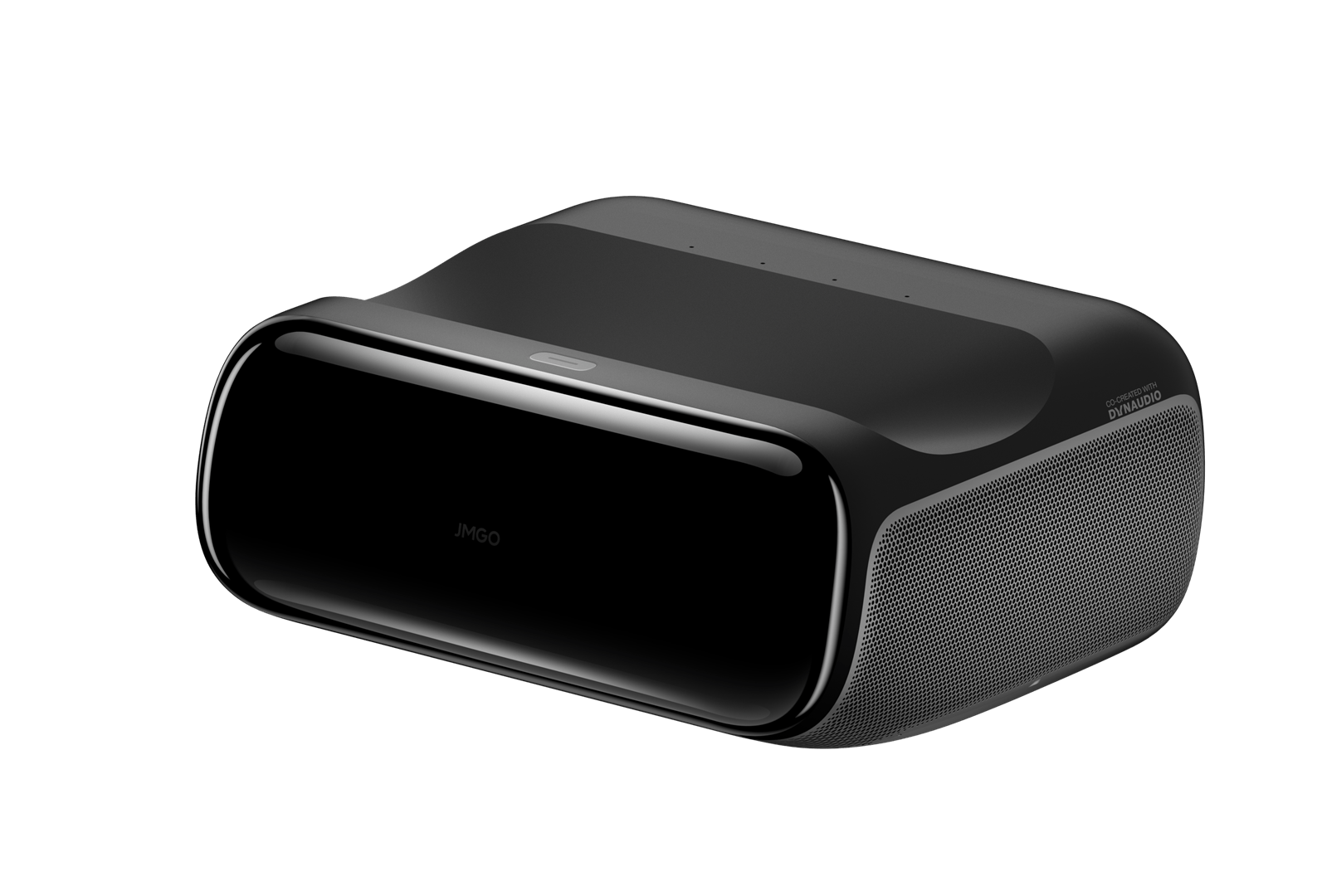
JMGO Previews N3 Ultimate, Showcases O2S Ultra Laser Projectors at CES 2026

0

The boundaries between the local multiplex and the modern living room are blurring further this week in Las Vegas. JMGO, a titan in the laser projection space, has arrived at CES 2026 to showcase two powerhouses that redefine what home entertainment looks like. By leveraging their world-class triple laser architecture, JMGO is moving beyond simple home movies into the realm of professional-grade immersion.

The N3 Ultimate: A Behemoth of Scale and Precision

For those who believe bigger is always better, the N3 Ultimate is the clear showstopper. This 4K industry-leader is designed to dominate the room, capable of casting a massive 300-inch display from just 5.84 meters away. It isn’t just about size, though; the next-gen triple laser system pumps out a staggering 5800 ISO lumens, ensuring that the picture remains vivid even in challenging lighting.

Setup is no longer a chore thanks to a sophisticated motorized gimbal, which allows for remote-controlled gesture adjustments. With a versatile 0.88–1.7:1 optical zoom and significant lens shift capabilities—up to ±130% vertical and ±53% horizontal—the N3 Ultimate offers the flexibility to fit almost any architectural layout. While it officially hits the market in Q2 2026, CES attendees can get an early-access preview now.

The O2S Ultra: Sophistication in a Shoebox

If the N3 is about grand scale, the O2S Ultra is a masterclass in compact efficiency. Retailing at $2,999 following its late 2025 rollout, this ultra-short-throw (UST) marvel fits a cinematic powerhouse into a frame no larger than a shoebox. It can project a crisp 100-inch 4K image while sitting a mere 6.6 inches from the wall, effectively eliminating the need for complex ceiling mounts or long cable runs.

Inside, the O2S Ultra is driven by MALC 3.0 Triple Laser technology, delivering 3600 ISO lumens and a stunning 4000:1 FOFO contrast ratio. With 110 percent BT.2020 color coverage and Dolby Vision support, it renders highlights and shadows with lifelike accuracy. The experience is topped off with modern conveniences like Google TV and Netflix built-in, plus a Fireplace Mode that works in tandem with an optional 120-inch motorized ALR floor-rising screen to create a cozy, ambient atmosphere when you aren’t watching a blockbuster.

Intelligent Integration and Safety

Both units represent a leap forward in user-centric design. The O2S Ultra specifically features intelligent wall color adaptation, automatic focus, and keystone correction to ensure the image is perfect regardless of the surface. To keep the home environment comfortable, JMGO has also integrated smart eye protection and screen-fitting software, making these high-performance machines as safe and easy to use as a standard television.

The Future of Home Cinema is Here

JMGO’s showcase at CES 2026 confirms that the next era of home cinema is centered on two things: immense brightness and effortless integration. Whether it is the massive 300-inch potential of the N3 Ultimate or the space-saving brilliance of the O2S Ultra, the theater experience is no longer a destination—it’s a permanent fixture of the modern home.

TCL NXTPAPER 70 Pro Brings Eye-Comfort Display Tech and AI Tools to Android at CES

0

TCL has expanded its NXTPAPER smartphone lineup with the introduction of the TCL NXTPAPER 70 Pro, a new Android device built around the company’s latest paper-like display technology and a growing set of AI-driven tools. Announced during CES, the NXTPAPER 70 Pro focuses on reducing eye strain across long sessions of reading, viewing, and everyday phone use, while still delivering the performance and features expected from a modern mid-range smartphone.

NXTPAPER 4.0 and the Dedicated NXTPAPER Key

At the heart of the NXTPAPER 70 Pro is TCL’s fourth-generation NXTPAPER display technology. A dedicated NXTPAPER Key on the side of the phone allows users to switch between three viewing modes with a single press: Color Paper Mode, Ink Paper Mode, and Max Ink Mode. Each mode adjusts color, contrast, and visual behavior to suit different tasks, from full-color media consumption to distraction-free monochrome reading.

Max Ink Mode leans heavily into the e-reader experience, turning the display into a black-and-white interface designed for focus and endurance. TCL claims up to seven days of reading time and as much as 26 days of standby in this mode. An included library of pre-installed books and AI-assisted reading features such as summaries, Q&A, audiobooks, and podcasts aim to make the phone feel closer to a dedicated reading device when needed.

Two smartphones placed on a light beige surface, one white and the other dark grey, showcasing their rear designs and dual camera setups.

Built for Long-Session Viewing Comfort

The NXTPAPER 70 Pro carries certifications from TÜV and SGS, reinforcing its focus on eye comfort. TCL highlights seven core eye-care technologies, including reduced blue light output, flicker-free operation, anti-glare surface treatment, and adaptive brightness and color temperature tuning.

The display uses nano-matrix lithography combined with software tuning to cut down on reflections in bright environments, helping content remain readable outdoors. For extended indoor use, hardware-level blue light purification reduces harmful blue light to a reported 3.41 percent. Circular polarized light helps preserve color accuracy while keeping the screen easier on the eyes during longer sessions.

For nighttime use, the phone supports dim-light eye protection with brightness levels that can drop as low as 1 nit. DC dimming removes visible flicker at the hardware level, a small detail that tends to matter most late at night when screens feel harsh faster than expected.

Pen Support and Creative Tools

A person holding a smartphone with a stylus, displaying a colorful digital collage of photos and notes, surrounded by artistic materials like colored pencils and rolled paper.

Paired with TCL’s optional T-Pen stylus, the NXTPAPER 70 Pro doubles as a digital notebook. The low-latency, pressure-sensitive input supports handwriting, off-screen notes, bullet journaling, and AI-generated covers. TCL positions the device as an all-in-one option for work, reading, and creative tasks, leaning into the idea that the display itself is the main productivity feature.

Cameras and Imaging Features

On the imaging side, the NXTPAPER 70 Pro features a 50-megapixel main camera with optical image stabilization, joined by a 32-megapixel front-facing camera for selfies and video calls. TCL’s MuseFilm imaging technology focuses on color tone and mood, with features such as a CCD-style film filter for a classic look and a super night mode designed to preserve detail in low-light scenes. Dual OIS and EIS stabilization, along with horizon lock, help steady video and action shots.

AI Features and Everyday Performance

AI tools play a large role across the system, from real-time translation and subtitles to voice memo transcription and summarization. Creative writing and text comprehension tools aim to streamline everyday tasks, while Google Gemini integration allows users to search and interact with content directly on the screen through gestures such as circling or highlighting.

A woman reading text on a smartphone in a dimly lit room, with art supplies visible in the background.

Under the hood, the phone runs on a MediaTek Dimensity 7300 processor with up to 24GB of RAM via memory expansion and storage options reaching 512GB. A 5,200mAh battery with 33W fast charging supports full-day use, and IP68 water and dust resistance adds durability for daily carry.

Pricing and Availability

The TCL NXTPAPER 70 Pro is priced at €339 for the 256GB model and €389 for the 512GB version, both bundled with accessories. Optional accessories include a stand case with T-Pen support. Availability is expected to begin in February across Europe, North America, Latin America, and APAC regions. More details can be found on TCL’s official website.

Roborock Expands Its CES 2026 Lineup With Stair-Climbing Robots and Robotic Lawn Care

0

Roborock arrived at CES 2026 with more than a single headline product. Alongside the newly announced Saros 20, the company outlined a broader slate of home robotics aimed at tackling spaces that have traditionally been off-limits for automated cleaning. The updates span experimental robot vacuums, refinements to existing product families, and the brand’s clearest push yet into robotic lawn care for North America.

For readers curious about the Saros 20 itself, that model anchors the lineup as Roborock’s latest flagship robot vacuum and mop, focusing on adaptive mobility, stronger navigation, and hands-free maintenance. The announcements below round out what else Roborock has in store.

Saros Rover Pushes Robotic Vacuums Beyond Flat Floors

Roborock Saros Rover robot vacuum with a wheel-leg architecture designed for navigating stairs and complex transitions.

The most unconventional reveal is the Roborock Saros Rover, a concept robot vacuum built around a wheel-leg architecture. Instead of rolling exclusively on wheels, each leg can lift, extend, and adjust independently, allowing the robot to navigate stairs, slopes, and complex transitions while actively cleaning them.

Roborock positions Saros Rover as a solution for multi-story homes where traditional robot vacuums stop at the first staircase. The system blends AI-driven motion control with 3D spatial awareness to adapt its movement in real time. While still in development with no confirmed release window, Saros Rover signals where Roborock sees the category heading: fewer “no-go” zones and far more autonomy across varied floor layouts.

Saros 20 Sonic and Qrevo Curv 2 Flow Broaden the Indoor Lineup

Image of a Roborock robotic vacuum cleaner in white color, showcasing its sleek design and advanced features.

Beyond the standard Saros 20, Roborock introduced the Roborock Saros 20 Sonic, which takes a different approach to flagship cleaning. It features an ultra-slim body paired with a sonic mopping system designed to scrub floors at high frequency while reaching closer to edges. Like Saros 20, it relies on Roborock’s high-power HyperForce suction and an upgraded RockDock that handles hot-water mop washing.

The familiar Qrevo family continues with the Roborock Qrevo Curv 2 Flow. This model introduces a roller-style mopping system with real-time self-cleaning, combined with edge-adaptive reach that extends the roller toward walls and corners. It is aimed at users who prioritize consistent wet cleaning performance on hard floors while still protecting carpets during mixed runs.

Roborock Enters the Robotic Lawn Care Space

CES 2026 also marks Roborock’s formal expansion into robotic lawn mowers for the North American market. Leading the charge is the Roborock RockMow X1 LiDAR, which uses LiDAR-based environmental perception, four-wheel drive traction, and active steering to manage uneven terrain and complex yard layouts. A standard Roborock RockMow X1 variant pairs RTK positioning with visual navigation for precise coverage and edge control.

For smaller yards, Roborock plans to offer the Roborock RockNeo Q1, positioned as a more accessible option that still uses stereo vision and RTK-assisted navigation. The mower lineup reflects Roborock’s intent to apply its indoor robotics experience to outdoor maintenance with minimal setup and ongoing intervention.

A Broader View of Roborock’s Direction

Taken together, these announcements frame Roborock’s CES presence as less about a single hero product and more about expanding what home robotics can reasonably handle. From stair-cleaning experiments to smarter mopping systems and autonomous lawn care, the company is clearly testing the boundaries of where robots fit into daily household routines.

The Saros 20 may be the most immediately relevant product for near-term buyers, but the surrounding lineup offers a preview of Roborock’s longer-term ambitions. Pricing, availability, and regional rollout details across the range remain to be shared, with more information expected as 2026 progresses.

Satechi Intros Thunderbolt 5 CubeDock and Pro Cable at CES 2026

0

At CES 2026, Satechi has officially entered the next era of connectivity by unveiling its first-ever Thunderbolt 5 hardware. The San Diego-based accessory maker is targeting high-end professionals and power users with a new docking station and a high-performance cable, both designed to maximize the massive bandwidth capabilities of Intel’s latest technology.

By moving to Thunderbolt 5, Satechi is offering a significant leap in speed, doubling the bi-directional throughput of previous generations to 80Gbps, with the ability to reach 120Gbps for video-heavy tasks.

“With the Thunderbolt 5 CubeDock, we aimed to provide desktop-grade functionality within a stylish, compact design. One cube with limitless connections,” stated Brock Guclu, President of Satechi. “The Thunderbolt 5 Pro Cable forms the perfect combination to integrate Thunderbolt 5 performance into daily configurations.”

The CubeDock: A Miniature Powerhouse for Professionals

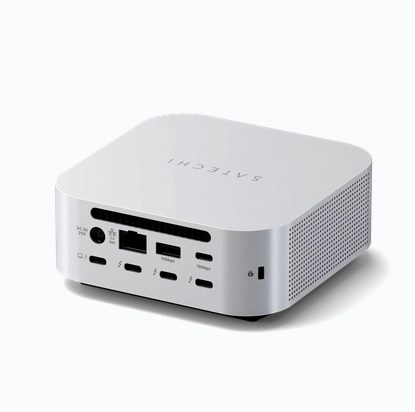
The centerpiece of the announcement is the Thunderbolt 5 CubeDock. Measuring just five inches square, this compact aluminum hub is designed to replace bulky desktop setups without sacrificing performance.

Beyond its connectivity, the CubeDock features a built-in NVMe SSD enclosure (PCIe 4×4), allowing users to add up to 8TB of high-speed storage (6000MB/s) directly into their docking station. To keep the hardware running smoothly under heavy data loads, Satechi integrated an adaptive active cooling system that manages heat while remaining nearly silent.

Key Technical Specs:

  • Video Support: Drives up to three 8K displays at 60Hz or three 4K displays at 144Hz (hardware dependent).
  • Power Delivery: Includes a 180W power supply capable of charging a host laptop at 140W via a single cable.
  • Port Array: Features three Thunderbolt 5 downstream ports, 2.5Gb Ethernet, and UHS-II card readers.

Maximizing Bandwidth with the Pro Cable

To complement the new dock, Satechi also released the Thunderbolt 5 Pro Cable. This isn’t just a standard connector; it is engineered to handle the 120Gbps Bandwidth Boost required for high-resolution multi-monitor setups.

The cable is built for longevity with a braided exterior and reinforced aluminum connectors. It supports 240W Power Delivery, making it capable of charging even the most power-hungry creative laptops. While it is built for the future, it remains fully backward compatible with Thunderbolt 4, Thunderbolt 3, and standard USB-C ports.

Launch Details and Promotional Pricing

Satechi is positioning these as premium tools for the modern workspace. The Thunderbolt 5 Pro Cable is available immediately for $39.99. The CubeDock is currently open for pre-orders at $399.99, with shipping expected to begin in early 2026.

CES Perk: Through January 31, 2026, users can apply the code CES2026 on Satechi’s website to receive a 20 percent discount on both new releases.

Roborock Saros 20 Debuts at CES 2026 With Adaptive Chassis and Fully Hands-Free Cleaning Ambitions

0

Roborock has pulled the curtain back on the Saros 20, its latest flagship robotic vacuum and mop designed to handle the kind of real-world obstacles that typically stop robovacs in their tracks. Introduced as part of the brand’s CES 2026 lineup, the Saros 20 leans hard into autonomy, mobility, and self-maintenance, aiming to reduce the number of times owners need to intervene mid-clean.

At a glance, Saros 20 is a premium robot vacuum and mop built for mixed flooring, deeper carpets, and busy homes with thresholds, rugs, pets, and clutter. Under the hood, it pairs a new adaptive chassis with upgraded navigation, stronger suction, and a significantly more capable docking station.

Roborock Saros 20 robotic vacuum and mop with a sleek design, showcasing its docking station and controls.

AdaptiLift Chassis 3.0 Targets Real-World Obstacles

One of the Saros 20’s headline upgrades is the new AdaptiLift Chassis 3.0. Instead of relying on fixed wheels, the system combines liftable main and auxiliary wheels with a climbing arm that actively analyzes floor transitions. The result is support for double-layer thresholds totaling up to 3.3 inches, which covers many door frames, step-downs, and uneven transitions found in older homes.

The chassis can also dynamically raise and lower itself during cleaning. On carpets, Saros 20 lifts its body to maintain suction and brush contact on rugs up to 1.18 inches tall, while adjusting wheel height independently if it needs to free itself from a tricky spot. The goal is simple: fewer rescues, fewer “robot stuck” notifications.

Close-up view of the Roborock Saros 20 robotic vacuum showcasing its internal mechanism and innovative chassis design against a dark background.

StarSight Autonomous System 2.0 Improves Mapping and Avoidance

Navigation duties fall to the StarSight Autonomous System 2.0, Roborock’s latest vision-based platform. It maps faster than traditional laser-based systems and recognizes more than 200 types of common household objects, including cables, pet toys, and small obstacles that typically require pre-tidying.

Roborock says the system samples its surroundings at a much higher frequency than LDS navigation, improving path accuracy and edge alignment. A slim 3.14-inch body height allows the Saros 20 to clean under low furniture, while side-facing sensing helps it follow walls and furniture lines with tighter precision.

Vacuuming and Mopping Adapt to the Floor Beneath

Saros 20 uses a triple-lift design that coordinates the chassis, main brush, and dual spinning mops in real time. On carpet, the mops lift or detach to keep fabrics dry while the brush and suction focus on debris removal. For hard floors, the main brush can lift during wet mopping to reduce dust streaking.

Vacuum power tops out at 35,000 Pa, paired with Roborock’s Dual Anti-Tangle System to manage long hair and pet fur. For mopping, the dual spinning pads rotate up to 200 times per minute and apply increased downward pressure when tougher stains are detected. A mop-only mode can be enabled for liquid messes to avoid spreading debris.

Edge cleaning gets extra attention via the FlexiArm system, which extends to reach baseboards and corners that many robot vacuums leave behind.

A New RockDock Focuses on Hands-Free Ownership

The redesigned RockDock is doing a lot of heavy lifting. It washes mops with hot water up to 212°F, dries them with warm air, empties dust automatically for up to 65 days, refills water, and dispenses detergent. There’s also an optional refill and drainage configuration for households that want fully automated water management, pending regional availability and installation requirements.

Fast charging rounds out the package, helping Saros 20 spend more time cleaning and less time parked.

App Features, Smart Controls, and Availability

Control runs through the Roborock app, where SmartPlan 3.0 adapts routines based on room type, floor material, and usage patterns. Users can fine-tune carpet behavior, enable advanced stain targeting, and integrate the robot into broader smart home setups via Matter, Alexa, Siri, or Google Home.

Roborock says the Saros 20 will roll out internationally in 2026. Pricing and regional availability have not been announced yet. More details can be found on Roborock’s official website as launch timing approaches.