PowerA is tapping into classic arcade memories with the launch of its PAC-MAN Neon Arcade Enhanced Wireless Controller for Nintendo Switch. Now available through PowerA.com and Amazon, this release completes the PAC-MAN x PowerA Collection, offering a bold nod to PAC-MAN’s iconic roots with a modern gaming twist.
A Retro Glow-Up for Modern Play
The PAC-MAN Neon Arcade Edition doesn’t just reference the past—it lights it up. Featuring PowerA’s Lumectra Ghost RGB LED lighting, the controller reveals a hidden PAC-MAN design in a glow that feels right out of an ’80s arcade. Players can cycle through four lighting modes to match their mood—or their high score energy.
Under the hood, the controller delivers all the performance features today’s Nintendo Switch players expect. Wireless connectivity, motion controls, and two mappable Advanced Gaming Buttons give gamers a competitive edge, while a rechargeable battery provides up to 10 hours of untethered play. A 10-foot USB-C cable is included for quick recharges between sessions.
The ergonomic design, complete with a textured grip and precision analog sticks, makes the controller comfortable for everything from quick rounds of PAC-MAN to marathon adventures.
PowerA backs the new controller, and all of its products, with a two-year limited warranty, adding extra peace of mind to the arcade-inspired excitement. More details on the full collection are available at PowerA.com.
LG Electronics USA has kicked off pre-orders for its 2025 QNED evo TV lineup, featuring two headlining models: the flagship QNED evo 92 (QNED92A) and the company’s first True Wireless QNED TV, the QNED evo 9M (QNED9MA). Both are now available for pre-order through LG.com.
Bright Colors, Sharp AI, and Cleaner Setups
QNED evo AI QNED92A 4K Smart TV 2025
The QNED evo 92 leads the charge with LG’s new Dynamic QNED Color Pro technology and mini-LED backlighting, promising vivid, accurate color reproduction across both light and dark scenes. Intertek certification confirms the lineup hits 100% color volume, making these TVs a strong fit for movie buffs and gamers chasing high-fidelity visuals.
Powering the QNED evo 92 is LG’s Alpha 8 AI Processor Gen2, which boosts both picture and audio performance. The chip analyzes content to better preserve the filmmaker’s intent, reduce noise, and render sharper faces, backgrounds, and text. It also brings improved audio capabilities, upscaling standard audio to a virtual 9.1.2 surround sound experience and enhancing vocal clarity by separating dialogue from ambient noise.
Going Wireless with the QNED evo 9M
LG QNED evo AI QNED9MA MiniLED 4K Smart TV 2025
The QNED evo 9M introduces True Wireless Video & Audio Transfer to the QNED series, a feature previously reserved for LG’s OLED evo M-Series. By using a separate Zero Connect Box, the 9M transmits up to 4K/144Hz video and audio without cables, except for power, giving users more freedom in how they arrange consoles, soundbars, and other devices.
This approach eliminates the clutter of HDMI cables while maintaining lag-free high-definition visuals, which will likely appeal to both gamers and those seeking a more minimalist setup.
Model Sizes and Pricing
Both models are available in multiple screen sizes, with pricing already listed for several configurations:
LG QNED evo 92 (QNED92A)
85-inch class: $3,499
75-inch class: $2,299
65-inch class: Available for pre-order in May
LG QNED evo 9M (QNED9MA)
86-inch class: $3,499
75-inch class: $2,299
65-inch class: $1,799
More models in the QNED 2025 series are expected to follow, with details on pricing and availability to be shared later. To learn more about the new lineup or to reserve a unit, visit LG.com.
Alienware has officially launched the AW3425DW, a revamped 34-inch QD-OLED ultrawide gaming monitor now available in North America for $799.99 USD at Alienware.com. The update brings faster refresh rates, an enhanced design, and connectivity tweaks that cater to modern PC and console gaming needs.
QD-OLED Visuals with a Performance Edge
The AW3425DW is built around a 3440×1440 (WQHD) QD-OLED panel with a cinematic 21:9 aspect ratio and immersive 1800R curvature. Now clocking in at 240Hz (up from 175Hz in the previous model), it offers 0.03ms response time and support for NVIDIA G-SYNC Compatible, AMD FreeSync Premium Pro, and VESA AdaptiveSync, aiming to deliver fluid motion with virtually no ghosting or screen tearing.
Color reproduction is equally impressive, boasting 99.3% DCI-P3 coverage, Delta E<2 accuracy, and support for VESA DisplayHDR True Black 400, giving gamers deep blacks and vibrant highlights.
Designed for Gamers Inside and Out
The monitor features Alienware’s AW30 design language, complete with the sleek Interstellar Indigo color finish and customizable AlienFX lighting. A compact base improves desk space efficiency, while a redesigned rear keeps cable clutter in check. It also includes ComfortView Plus, a hardware-based low blue light filter that preserves color fidelity while reducing eye strain.
Connectivity and Convenience
Inputs include HDMI 2.1 FRL and DisplayPort 1.4, enabling full WQHD resolution at 240Hz across PCs and consoles. USB-C and standard USB 5Gbps ports offer additional flexibility, with 15W device charging via the downstream USB-C port. Gamers can also take advantage of Picture-in-Picture and Picture-by-Picture modes.
Built to Last, Built Responsibly
Alienware backs the AW3425DW with a 3-year Premium Panel Warranty covering OLED burn-in, plus Advanced Exchange Service. Anti-burn-in technology is built-in to extend panel life, and the packaging is 100% recyclable and FSC-certified, a small nod to sustainability in a category not known for it.
The team behind Bird Buddy, the creators of the world’s first smart bird feeder and a TIME Best Invention of 2023, is back with a new project: Wonder Blocks. Launching today on Kickstarter, Wonder Blocks pairs modular pollinator habitats with an AI-powered camera called Petal, transforming backyards, balconies, and gardens into intelligent, living observatories.
Building a Thriving Ecosystem at Home
Wonder Blocks is designed to support pollinators like solitary bees, butterflies, and hummingbirds by offering them food, shelter, and hydration. Each module features a blend of science-backed design and stylish form, making it easier for anyone to nurture local biodiversity.
At the heart of the system is Petal, a compact, detachable camera packed with AI smarts. Petal identifies over 2,000 species in real time, from pollinators and birds to native plants, and automatically turns encounters into BBC Earth–style narrated clips using its built-in storytelling engine, Nature’s Voice.
“Wonder Blocks is about more than just observing nature – it’s about understanding it, and helping it thrive,” said Franci Zidar, co-founder and CEO of Bird Buddy. “This is conservation made accessible, emotional, and intelligent.”
Key Features of Wonder Blocks and Petal
The Frame: A sleek, magnetic trellis that holds habitat modules, butterfly and hummingbird feeders, shelters, and the Petal camera (Hero version).
Bee Habitat and Observatory: Safe nesting spaces for solitary bees, with the option to mount Petal for unobtrusive observation.
The Stream: A built-in micro water feature offering critical hydration and a calming visual accent.
Smart Habitat Planter: A self-watering planter designed to foster pollinator-friendly plants and enhance local ecosystems.
Meanwhile, Petal’s feature set extends well beyond species recognition. Its dual-lens system captures both sweeping landscapes and intimate details, while its Nature Intelligence monitors environmental changes and nesting behavior. An Impact Score helps users visualize how their gardens contribute to biodiversity over time.
Availability and Pre-Order Details
Wonder Blocks and Petal are now available for pre-order on Kickstarter, starting at $129, with shipping expected in mid-2026. More details can be found through the official Bird Buddy website.
Bird Buddy’s goal remains clear: to strengthen people’s connection with nature and make conservation efforts tangible at home, one smart habitat at a time.
I’ll be honest, when I first heard about Yarbo, I wasn’t sure what to think. A modular yard robot that snow blows, mows the lawn, and even clears leaves? That sounded ambitious, to say the least. But the idea stuck with me: one machine, year-round use, with swappable modules for different tasks. No more juggling separate seasonal machines and no more winter storage shuffles? I decided to try it out.
The Yarbo team sent me pretty much all of the major components back in January and I’ve been testing them out over the last few months. As the weather has finally given way to more than a few dry and warm days in a row, I’ve been able to try just about everything now.
Yarbo calls it “the world’s first modular yard robot,” and while that kind of marketing usually makes me skeptical, in this case, it’s not wrong. At least from what I have seen come across my path.
The Core is the brain and body, and it works with attachments that transform it into a snow blower, lawn mower, and blower. And with more modules arriving now and in the future, the system feels like an investment that could grow with one’s needs.
With Yarbo, a single smart system replaces seasonal machines, cuts down on upkeep time, and grows with your needs. it’s a smart investment in long-term yard care.
Out of the box, you get the robot itself, a docking station, rechargeable battery, and a remote control (think Bluetooth Playstation controller) for manual operation.
It’s an appealing concept if you’ve ever looked at your garage or shed and thought, “Why do I own so many machines for outdoor upkeep?” The Yarbo Core tackles that question head-on, and after spending real time with it over a few long and cold winter months and a few wet spring ones, I’ve got some feedback to share.
My goal is to return later with a follow-up piece that tackles longer term usage, build quality, general performance, and other modules. I’m thinking maybe something later this summer, perhaps.
Build Quality That Feels Serious
The Yarbo Core isn’t a toy, it’s a hefty, tank-like machine that commands presence. At over 130 pounds, it’s built for stability, and that comes through especially in the snow. It rolls on a tracked tank-tread like wheel system, which helps it grip slippery or uneven surfaces, and handles up to 35% inclines without complaint. It’s rated IPX5 for water resistance, so it doesn’t shy away from wet conditions or unpredictable weather.
All of the modules I’ve spent time with feel thoughtfully engineered. The Snow Blower Module is a beast in its own right, over 75 pounds with a two-stage blower, adjustable chute, and serious snow-throwing power.
The Lawn Mower Module, which I hope to fully utilize in the very near future, is lighter but wider, with a front-mounted cutting deck, dual discs, and a torsion-flex frame that lets it adapt to bumps and slopes.
The Blower Module, which just recently arrived, doesn’t just look like a leaf blower on steroids, it is one, with air velocity up to 190 MPH and 760 CFM. It’s surprisingly strong.
I did notice one thing about the system early on: swapping modules is a bit of a chore, especially solo. They’re heavy, and there are wires to manage.
Smart, Capable, and (Mostly) Autonomous
At the heart of the Yarbo Core is a robust navigation system. It uses Stereo Vision, Odometry, and dual antennas to navigate without boundary wires, and it holds its position even when GPS gets sketchy, like under dense trees or near buildings. Obstacle detection is proactive, pausing the robot if anything gets in the way. It’ll return to the dock and recharge itself when needed, and you can set boundaries and tasks through a smartphone app.
There’s even a security mode built in. Using front and side cameras, Yarbo can patrol your yard and stream real-time footage to your phone. It’s a bit of a novelty, but also a cool crossover between yard care and smart home security.
Each module adds its own twist. The Snow Blower can toss snow up to 40 feet, and it handles up to a foot of accumulation without issue. The Lawn Mower promises up to six acres of coverage and supports multi-zone planning, so you can map complex yards with ease.
The Setup Process: Not Plug-and-Play
Let’s talk about setup, because this isn’t a toaster oven. There’s a fair amount of time and work that you’ll need to invest. You’ll need to mount the RTK antenna somewhere with a clear view of the sky, ideally on a pole. Then, there’s the wiring, Wi-Fi setup, yard mapping, firmware updates. Suffice it to say, it’s a bit of a project. If you’re not comfortable with light DIY and tech troubleshooting, you’ll want a helping hand.
In fact, I avoided the full setup for a few months because it was so cold and snowy here in Ohio. I opted instead to use the wireless controller and/or my phone’s app to manually run the Snow Blower and plow.
It was not until early April that I set up the docking station and did the mapping of my yard. And as I look ahead on my calendar, I’ll have to make some adjustments in the next month. My flower and mulch bed is being reshaped so I’ll ultimately end up with more lawn to cover.
Mapping your yard in the app is straightforward, but it hinges on the antenna’s position and you’ll need to have the docking station/wireless charger in place first. Move either later, and you’ll potentially need to remap everything. This amounts to more or less manually driving the Yarbo around your property’s edges and creating work zones.
Much like you’ll encounter with a quality robot vacuum, you can create no-go zones or areas to avoid. Similarly, you can create sections of yard so that you can focus on one area more than others. Say, for instance, you want to keep that nice curb appeal and have the Yarbo cut grass every other day while the back yard could get spaced out a little longer.
I found that the module swap process, while conceptually simple, requires some muscle and patience. The snow module in particular is heavy and awkward to align precisely. And the mower module, while lighter, has some clips you’ll have to lock into place.
That said, once the system is up and running, it’s pretty smooth sailing. I did have to reboot the Core and data center once to fix a firmware hiccup, and snow buildup on the docking station created one failed docking event. But overall, the tech has held together well thus far.
I was surprised at the customization features and settings for each module. As wonky as it might be to operate with your phone or controller, you can adjust heights for grass or snow clearing, direction for snow blowing, patterns for mowing the grass, and more. I suspect that the more time I spend with this unit over the summer, the more I’ll come to enjoy its capabilities.
Real-World Performance
The Snow Blower impressed me quite a bit and it made my neighbors jealous to be sure. It chewed through light and moderate snow with no problem, and even handled snow berms at the edge of my driveway that were left by plows. Wet, slushy snow did gum up the auger a bit, but that’s a common challenge for any blower.
One of my favorite early moments with the Yarbo Snow Blower was sitting in my living room, coffee in hand, and watching it clear the driveway, all with me barely lifting a finger. I hadn’t even finished the full installation yet. No mapping, no geofencing. Just me using the app, tapping a few buttons on my phone, and driving like I was playing Asphalt 9.
It was surreal watching this tank-like robot do the hard work outside while I stayed warm and dry inside. That little glimpse of hands-off winter maintenance? Totally sold me on the potential. And I know that next winter things will be even better with the automation getting tighter and cleaner lines without me standing guard. I look forward to a mapped out and fully customized work schedule.
As for the Blower Module, it’s powerful. It makes quick work of leaf piles and debris, especially with the follow mode turned on. It’s also quieter than expected, and Yarbo says the Lawn Mower tops out around 60 dB which is about as loud as a conversation. That’s a win in my book. In fact, the first time I had the blades going, I was talking to my neighbor across the yard. They had no idea the Yarbo was powered on let alone the blades spinning.
One of my biggest problems with maintaining my lawn is finding the right balance of time and availability, and then making sure the weather is nice enough. In March and April that’s a big ask but things do even out a bit come May. I’m excited at the prospect of getting sections of my yard in between rainfall and/or having it run in a light drizzle when I don’t want to be outside.
Battery Life and Charging
Battery life depends on the module and workload. The Core runs about four hours per charge. The Snow Blower gets roughly 90 minutes while the Blower Module nets about 70 minutes. The Lawn Mower should land around 3.5-5 hours but I suspect I’ll not come near that with the size of my yard. Charging is wireless via the dock, which feels like a little magic every time it works.
For the first few months I was content to drive the unit back into my garage and plug it in manually. Once the weather started to break, and I was able to clean the garage out a bit, I opted for that handy charging mat/dock. The dock comes with a number of long screws to ensure it does not go anywhere or slide around as the Yarbo returns to charge up.
What About the Price?
Let’s talk dollars. The Core costs around $5,700. Modules look to be priced from about $1,100 on up with bundles available if you want to snag a few items at once. The Snow + Lawn combo runs about $8,700, while the full 4-in-1 system is closer to $9,700.
Current Pricing on Yarbo’s Website
Here are a few bundled options to consider, with their pricing as of late April.
Note: The bundles include a Yarbo battery, docking station, smart assist module, data center, and remote controller set.
That’s a lot, no doubt. But if you’re someone who already owns (or pays for) multiple seasonal machines, or might be aging out of dealing with heavy manual yard work, it starts to make more sense. There’s something to be said for consolidating multiple tools into one smart system that can grow with software and hardware updates.
I did some quick shopping for a new snowblower with similar features and found that I’m looking at $1,200 or more for one. Factor in a blower of around $200, a minimum of $2,000 for a riding mower, and you’re already facing down $4,000.
Now, consider how much your time is worth. Let’s say it takes you two or so hours a week to mow and that your time is valued at just $25 per hour. Toss in gas and oil, cleanup and showering after, and that’s got to be $300 or more per month, or $1,500 – $1,800 for a summer.
Come winter, one might value that time even higher, so shoveling snow could be valued at $1,000 over a winter. Repeat this a year or two and you can truly start to see the value. Got a lawn guy or a person to plow your driveway? You might actually be paying more.
Then there’s the space savings, too.
Support and Warranty
The Core and most modules come with a 2-year warranty, while the Blower gets three years. I reached out to support twice, and both times got fast, helpful replies. That kind of service matters, especially with a premium product like this.
We know a good thing when we see it.
The First-Rate Find badge recognizes products that go beyond standards in performance, design, value, and/or innovation. They also tend to boast interesting features or distinct hallmarks.
We don’t need to assign any formal scores to indicate that this one is worth your attention.
The Bottom Line so Far
Would I recommend the Yarbo and/or its bundles? If you’re tech-savvy, have a decent-sized yard, and want to reduce the time and effort you put into outdoor maintenance, it’s a compelling solution. It’s not perfect as setup has a learning curve, and module swaps can feel a touch cumbersome, but the overall experience has been positive.
There’s a certain thrill in watching a machine take over your least favorite chores. I’ve shoveled snow, mowed lawns, and raked leaves for years. Now, I have the ability to just supervise with very little human touch. So yes, it’s an investment. But, to me, the time and energy saved seem like they are more than worth it.
MobileX, the wireless service known for its ultra-customizable plans, is broadening its horizons with new devices, smarter tools, and more affordable options aimed at keeping customers in full control of their mobile experience. The company announced the availability of the latest iPhone 16 and Samsung S25 smartphones, along with flexible data-only plans tailored for iPads and Android tablets.
Smarter AI Tools, Smarter Savings
At the core of MobileX’s refresh is a major upgrade to its AI-powered plan prediction engine. The improved model now forecasts data usage twice as fast and with 50% better accuracy, helping new customers land on a plan that fits their actual usage patterns in as little as two to ten days. For customers tired of bloated bills and confusing rate structures, MobileX’s approach is refreshingly straightforward: pay only for what you need.
Founder and CEO Peter Adderton emphasized that MobileX is “putting the power of choice, flexibility, and savings directly in the hands of consumers.” Tablet users in particular get an extra incentive—unused data gets credited back, making it even easier to save.
New Devices and Easy Activation
MobileX customers can now purchase unlocked versions of the iPhone 16 and Samsung S25 through the company’s website, with each device backed by a 60-day warranty and a MobileX SIM Kit for quick setup. Financing options through Affirm are available for those who prefer a payment plan, making it simpler to get the latest tech without the financial strain.
Customers can either bring their own unlocked phones or pick from new and certified pre-owned devices, all ready to connect to one of America’s fastest 5G networks.
Flexible Plans for Every Type of User
MobileX now supports three distinct ways to get started:
Need a Hand: For $4.88, customers can enter a 10-day AI learning period to find their ideal plan. A credit of up to $4.88 applies toward the final plan choice.
Unlimited Plans: Options start at $14.88 per month for 10GB of high-speed data, or $24.88 per month for truly unlimited data, with unlimited talk and text nationwide. International calling to over 100 countries can be added for $2 per month.
Build Your Own Plan: Users can customize their talk, text, and data starting as low as $3.48 per month. Data-only plans for tablets start at $4.08 per month, and any surplus data rolls over.
Extras like Premium Caller ID and Advanced Spam Filtering are available starting at just $0.50 per month.
Easy Access at Home and in Stores
The MobileX app is available for download on Apple and Google Play app stores, supporting activation with either a physical SIM or an eSIM. Customers can also find MobileX products at approximately 3,700 Walmart stores nationwide and on Walmart.com.
More details can be found by visiting mymobilex.com.
People around the world have different hobbies. Some take up sports, others get creative with clay modeling, and some are passionate about video games. There’s also another group of people emerging in recent years that take up online casino gaming as a pastime.
Gambling is often seen in a negative light, so many wonder why anyone would make a hobby out of it. However, with the right approach and if you don’t consider it a source of income, it can be one of the most fun pastimes.
Delving Into the Unknown
If there’s one factor that intrigues people into taking online casino gaming as a pastime, it’s the excitement of the unknown. Some players will say that the games are rigged, but that’s not the case. Reputable casino sites such as the ones featured at wsn.com can be trusted, so you don’t have to worry about any rigged games. You can play your favorites without knowing what happens next, and that’s a huge draw for most players.
Think of it as an adventure for your brain and a roller-coaster ride. The fact is that online casinos are fun and so are the games. There’s nothing like waiting for the ball to land in a roulette pocket, or spinning the slot and hitting a big-win combo. Of course, you should make sure to do it responsibly, but if you’re looking at it as a fun activity and know when to stop, the excitement never ends.
Lucrative Opportunities
Another major reason why people take up online gaming as a pastime is the potential profit. Unlike other hobbies, this one can pay off big time. Of course, there’s no guarantee that you’ll ever hit anything, but considering the jackpots some online slots offer, many people are willing to give it a try.
No one won the bingo jackpot without buying a ticket first. You can set limits on your spending when spinning jackpot slots, and still get an opportunity to win big. Elsewhere, using tested strategies can prove a lucrative tactic to get the most out of skill-based games such as blackjack. One way or another, you can win big in online casino games, and the lucrative aspect is the main reason why it’s such a popular pastime around the world.
Bonuses and Promotions – Play Without Spending!
Compared to casinos on the Strip, you won’t get free drinks or lavish hotel suites when playing casino games online. Instead, they offer a wide range of bonuses and promotions, which might be even better than comps.
Most casino sites will welcome you with open arms and a generous welcome package. It’s usually a 100% first deposit bonus, which doubles your initial deposit. Think about it – you’ll have double the money to start with. Of course, the money doesn’t come for free. But if you stick to the rules, you’ll likely be able to claim your winnings with ease.
There are also many other bonuses to claim and play without spending a lot of money. These include no deposit offers, free spins, cashbacks, reloads, and more.
No Need to Pay
If you don’t want to spend money on casino games, you don’t have to at online casinos. Unlike at land-based casinos, you can play games for free online and without limits. Many casino sites will allow you to play games for free without creating an account, making it an even larger draw for new players.
Most casino games are available for free, with the exception of live dealer games. They offer an immersive experience, but you can only play them for real money.
High-Stakes Games
Some people are more competitive than others and are always looking for high-stakes excitement. It doesn’t get any better than online casinos, where you can take part in various tournaments in poker, blackjack or any other game.
Playing high-stakes poker is an art form of its own. You need a good strategy to take other players out, and that’s easier said than done. The good news is that you can do a lot of practice online before you enter the high-stakes ring and go for the top prizes.
EDITOR NOTE: This is a promoted post and should not be considered an editorial endorsement. AndroidGuys received compensation for the aforementioned content.
Please exercise caution when using a gambling or betting service which employs real money.
If you reside in a location where gambling, sports betting or betting over the internet or through an is illegal, please do not click on anything related to these activities within this post. You must be of proper legal age to click on any betting or gambling related items even if it is legal to do so in your country.
There’s something about vinyl that’s hard to replace. The feel of placing a record on a platter… the little crackle when the needle touches down. If you know, you know. Traditional vinyl setups? In 2025? They’re not always friendly.
Between separate amps, finicky cables, and clunky speakers, it’s easy to get overwhelmed. That’s where the Mixx Analog System 5 comes in.
It’s an all-in-one setup with wireless speakers, a modern turntable, and a clean, minimalist vibe. And for just under $300, it punches well above its weight.
The Mixx Analog System 5 strips away the cables and complexity, giving you warm, full vinyl sound in a sleek, all-in-one setup that’s ready to play in minutes
I spent some real time with it, and while it won’t replace a full high-end hi-fi system for hardcore audiophiles, I came away impressed with how easy it is to use, how good it sounds, and just how nicely it fits into a living space.
Looks the Part, Sounds Even Better
The first thing I noticed about the Mixx Analog System 5 is how sharp it looks. The turntable is set on a wooden plinth, either black or white, both very sleek, with a clear dust cover that keeps the whole thing feeling modern and tidy. Anti-vibration feet on the bottom help keep playback stable, and it’s honestly the kind of setup that just looks right in a living room.
The two wireless speakers are equally understated. No flashy lights or weird buttons, just clean, minimal blocks that blend in easily. Each speaker kicks out 50W RMS, which was more than enough to fill my medium-sized rooms with sound.
Vinyl Done Right, Without the Hassle
The turntable itself is belt-driven, which helps cut down on motor noise and vibrations. It supports both 33 ⅓ and 45 RPM, so you can switch between LPs and singles without fuss. Mixx also went with the Audio-Technica AT3600L cartridge, a moving magnet model that’s well-respected and genuinely delivers solid tracking and clarity.
You also get a lightweight aluminum tonearm, pitch control for speed tweaks, and an anti-slip mat for better record stability. It’s all very plug-and-play with no cartridge alignment headaches or fiddling with counterweights.
It’s Wireless But not Just Wireless
The standout feature here is the wireless connection between the turntable and the speakers. No speaker wire. No amp. You plug in the turntable, pair it to the speakers via Bluetooth, and you’re off. It’s not just limited to vinyl either; Bluetooth input means you can stream from your phone or tablet when you’re not spinning records.
If you prefer wired connections, both the turntable and speakers support RCA, and the speakers even add an optical input for TVs or other digital sources. And yes, there’s a remote. It runs on AA batteries (included) and gives you easy access to volume and input controls from across the room.
Quick Setup, no Stress
Getting this system up and running took maybe 15 minutes, tops. The turntable and speakers connect wirelessly, so I didn’t need to snake cables across the room. Everything you need (power adapter, RCA cables, 45 RPM adapter, dust cover) is in the box.
Pairing the turntable and speakers via Bluetooth was just a few button presses. It’s one of the most stress-free vinyl setups I’ve ever used.
So How Does it Sound?
For something this compact, it sounds surprisingly full. The AT3600L cartridge pulls out a lot of detail, and the dual 50W speakers have decent low-end punch without overwhelming the mids or highs. There’s no harshness and no muddiness. It’s just a warm, well-rounded sound that does justice to most records. Again, if you know, you know.
Are there better speakers out there? Of course. If you’re chasing reference-grade fidelity, a dedicated setup with a beefy amp and passive speakers will outperform this. But for casual listening or even serious weekend spins, I found it genuinely enjoyable.
One thing to note: since audio from the turntable to the speakers travels over Bluetooth, purists might raise an eyebrow. If you’re sensitive to compression or crave that analog signal path, you might prefer a wired system. But for 99% of people, the convenience here outweighs any slight drop in fidelity.
A Full System for Under $300?
At around $299.99 in the US (or £279 in the UK), this thing feels like a steal. You’re getting a solid belt-drive turntable, a good-quality Audio-Technica cartridge, dual 50W speakers, Bluetooth streaming, and all the accessories you need.
If you were to piece together a similar setup from scratch (turntable, speakers, and amp) it’d easily cost more. So from a value standpoint, the Mixx Analog System 5 really delivers, especially for newcomers to vinyl or casuals who want something clean, compact, and reliable. And thanks to the Bluetooth connectivity, you can use the system while you build your record collection.
A Quick Word on Warranty and Power
Mixx backs this system with a 2-year warranty, which covers defects under normal use. Some retailers offer extended protection plans if you want extra peace of mind. Most of the power comes from a standard AC adapter, though the remote uses a pair of AA batteries. There’s no battery-powered playback here. It’s a system meant to be plugged in and stay put.
Awarded to products with an average rating of 3.75 stars or higher, the AndroidGuys Smart Pick recognizes a balance of quality, performance, and value.
Products with this distinction deserve to be on your short list of purchase candidates.
Final Thoughts: This Thing Gets a Lot Right
If you’ve been curious about vinyl, or maybe just want a simpler way to enjoy your collection without diving down the audiophile rabbit hole, the Mixx Analog System 5 hits a really sweet spot. It’s attractive, simple to set up, easy to live with, and it sounds genuinely good.
It’s not for everyone. If you demand ultra-high fidelity or need tons of connectivity options, you might want to build out a more custom system. But for anyone looking for a sleek, wireless vinyl experience that doesn’t compromise on the basics, this one’s easy to recommend.
One of the main attractions that brought me to the world of Apple is the sheer amount of accessories options. From cases for my phone, to elaborate keyboards for the new iPad Air, the availability of more cool gadgets made to work with these devices is fantastic and truly enhances the overall user experience.
Whether you’re a casual user or a professional, having the right accessories can make all the difference in productivity and enjoyment. ESR Tech has become one of the leaders of this market, offering innovative and stylish solutions that cater to various needs. In this piece, we take a detailed look at its latest lineup surrounding the iPad series, which showcases cutting-edge designs and functionality.
Level Up is where we explore the gear that actually makes a difference, whether that’s in how you live, work, or unwind. Each edition brings together standout products, whether tied by brand or by theme, that turn the everyday into something a little more exceptional.
Among the standout products are the ESR Rebound 360 Keyboard case, which provides versatile typing options along with protective capabilities, the Flip Magnetic case that combines elegance with practicality, and the new Geo Pencil, designed for artists and note-takers alike to elevate their creative processes.
ESR’s latest iPad accessories strike the perfect balance of style, function, and peace of mind, from a protective keyboard case that rivals Apple’s own, to a $32 smart pencil you can actually track with Find My.
ESR Rebound 360 Keyboard Case
Let’s start with the most feature-rich option in this suit of accessories. Essentially, ESR has taken the Apple Magic Keyboard and tweaked it a bit. This makes it more cost-effective, but also makes it slightly better in my opinion.
The Rebound 360 has the same basic hinge and magnetic mounting system. The keyboard is very similar as well. It connects over Bluetooth instead of the proprietary Apple pins, but that’s not an issue either way. This means it also has a separate charging connection, but the Rebound 360 lasts for days with no issue.
Where it expands the functionality is, the Rebound 360 adds a protective silicone case that’s meant to be used in conjunction with the keyboard. Having full-time fall protection for your iPad Air while still being able to use the magnetic mount and keyboard makes this keyboard combo a real standout. Even over the Apple official Magic Keyboard.
The ESR isn’t breaking the bank here either, with the Rebound 360 Keyboard case coming through ESR and Amazon at just $125.
ESR Flip Magnetic Case with Pencil Holder
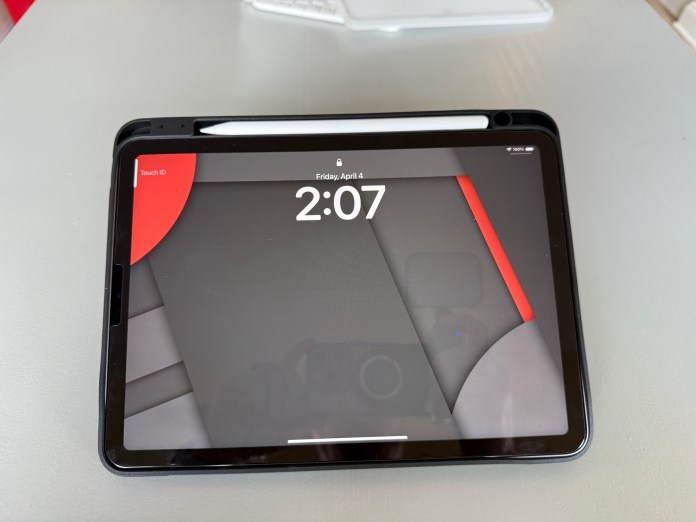
Next up is the new Flip Magnetic case from ESR Tech. This portfolio case has a unique magnetic stand and pencil slot to hold an official Apple Pencil, or a certain one covered here later. The magnets don’t just stop with the Flips mounting system of the iPad Air. The actual kickstand mechanism also has magnets built in to accommodate multiple viewing angles and orientations.
And in true ESR fashion, the Flip Magnetic case makes sure you have ample protection for your new Apple tablet. Yes, you can magnetically attach the Flip case directly to the back of the iPad Air, but using the additional case found in the box, you have a silicone layer of security to make sure your new iPad can take some bumps and bruises along the way.
With a price tag of just $30 for the iPad Air 11 series, and another $10 for the larger 13, this thing is a steal. Grab yours from ESR or Amazon today.
ESR Geo Digital Pencil with Find My
Lastly, we have the latest addition to the ESR Tech family in the Geo Digital Pencil with Find My for the iPad. This Bluetooth pencil function very similarly to the official Apple Pencil, with an almost identical footprint. I’ve had zero issues using it for text input or my occasional doodling sessions, much like I would with my Apple Pencil.
The ESR Geo Digital Pencil sets itself apart by offering something I’m honestly shocked Apple’s offering doesn’t already feature: Find My Device support. Yep, the next time this falls between your couch cushions, you can simply track down the Geo Pencil with your Apple devices. I can’t express how much more piece of mind you’ll have with the ESR Geo Digital Pencil once you have it set up in Find My and can just see it anytime you’d like.
At just $32, anyone who has lost an Apple Pencil before should be running to snag the new ESR Geo Digital Pencil from ESR and Amazon.
JLab is recognized as one of the pioneers in the wireless accessory market as the company has been making Bluetooth-connected devices for over two decades. The latest premium option from JLab is the Epic Lux Lab Edition active noise-cancelling headphones. We took these for a spin for usage over a month to help shape this review. Since the name is such a mouthful, and for the sake of brevity, I’m going to refer to them as the Epic Lux headphones.
Design and Comfort
JLab’s design team has achieved a perfect harmony between the classic over-ear headphone look, user comfort, and internal tech innovation. I found the more oval ear cups particularly appealing, making the Epic Lux surprisingly compact and easy to store. This smart design choice allows you to slip them into a bag or backpack without hassle, while their distinct shape helps them stand out in a crowded market.
Comfort is clearly a top priority here, and the Epic Lux nails it. The headband and ear cushions are luxuriously padded, offering a plush, comfortable fit even during marathon listening sessions. They can get a bit warm after a while, but the premium materials ensure they never feel uncomfortable. Despite their solid build, the headphones are well-balanced on the head, avoiding any awkward pressure points.
Another thoughtful touch is the inclusion of a touch control area. The right ear cup features volume controls with a play/pause, forward/previous, and volume nestled in the middle via swipe gestures. A dedicated power button provides a satisfying click when powering on or off. Just below these controls, you’ll find a USB-C charging port for when you need an audio break to top of the battery.
On the left ear cup, the layout is similar but simpler. This side of the Lux is completely void of buttons, with just a JLab logo, but you’ll find out why in the battery section later in this review. Overall, the Epic Lux design speaks volumes about JLab’s attention to detail, balance, and build quality.
“The JLab Epic Lux Lab Edition delivers impressive noise cancellation, all-day comfort, and rich sound quality—proof that premium listening doesn’t have to come with a premium price. Whether you’re commuting, working, or unwinding at home, these headphones provide a seamless audio experience that fits into any lifestyle.”
Sound Quality
At the heart of any headphone is its sound, and the Epic Lux doesn’t disappoint. The audio performance is genuinely impressive and more than holds its own against bigger brands. Noise cancellation is solid, effectively muting much of the surrounding environment. While it might not reach the absolute pinnacle of ANC technology, it handles itself admirably even in moderately noisy settings.
Straight out of the box, the Epic Lux delivers a rich and well-rounded sound profile that most users will appreciate. For those who prefer a custom audio experience, the JLab app provides an easy way to tweak EQ settings and fine-tune the sound to your liking.
Battery Life
One of the perks of the larger over-ear form factor is more room for battery capacity, and JLab makes excellent use of it. The Epic Lux promises up to 60 hours of playtime with ANC on and a remarkable 90 hours with ANC off. Endurance is key for any wirelessly connected device, and runtimes like this positions the Epic Lux at the top of the market.
Not only does the USB-C power port available when you do run out of power, the Epic Lux Lab Edition has a unique charging solution included in the box. This comes in the form of essentially a MagSafe charging puck. The left ear cup has a magnetic inductive charging cover that when paired with the charger makes for seamless wireless charging.
Final Verdict
Awarded to products with an average rating of 3.75 stars or higher, the AndroidGuys Smart Pick recognizes a balance of quality, performance, and value.
Products with this distinction deserve to be on your short list of purchase candidates.
For under $200, the JLab Epic Lux Lab Edition packs an incredible punch. With excellent noise-canceling, a comfortable and durable design, long battery life, and vibrant sound quality, they’re a serious contender in the ANC headphone space. If you’re looking for a premium listening experience without a hefty price tag, these headphones are an outstanding choice.
Entering the premium ANC market comes with plenty of competition. JLab had to bring its “A-game” to make the Epic Lux Lab Editions compelling, and the company seems to have met that expectation.